CTFL_Syll_4.0 Exam Questions & Answers
ISTQB Certified Tester Foundation Level (CTFL) v4.0 • iSQI
100% money-back guarantee
Sample CTFL_Syll_4.0 Questions
Practice with real exam-style questions, each with the verified correct answer and explanation.
Which of the following is LEAST likely to describe a task performed by someone in a testing role?
In the context of software testing roles, tasks typically performed by someone in a testing role include evaluating the test basis and test object, creating test completion reports, and assessing the testability of the test object. These tasks are directly related to ensuring the quality and effectiveness of the software testing process.
Evaluate test basis and test object: This involves reviewing and analyzing the documents and artifacts that are used as the basis for testing. This is a fundamental task for testers to understand what needs to be tested and to ensure that the test objects are adequately covered by the test cases.
Create test completion report: This is part of the test closure activities. Testers are responsible for summarizing the testing activities, outcomes, and lessons learned, which are compiled into a test completion report. This report is crucial for stakeholders to understand the test results and make informed decisions.
Assess testability of test object: This task involves evaluating how easily a test object (such as a piece of software) can be tested. This includes considering aspects such as the availability of test data, the ability to isolate the object for testing, and the clarity of the requirements. Testers often perform this assessment to identify potential challenges and mitigate them before testing begins.
On the other hand:
Define test environment requirements: While testers may provide input on the test environment, the primary responsibility for defining and setting up the test environment usually falls to roles such as system administrators or infrastructure specialists. They ensure that the necessary hardware, software, and network configurations are in place for testing to proceed. This task is less likely to be the sole responsibility of a tester.
A document describes the test procedures that have been derived for the identified test sets. Among other things, the order in which the test cases in the corresponding test set are to be executed according to the dependencies described by preconditions and postconditions is specified. This document is a typical work product produced as part of:
The document that describes the test procedures, including the order in which test cases are to be executed according to dependencies described by preconditions and postconditions, is typically produced during the test implementation phase. During this phase, detailed test procedures and scripts are developed, organized, and prioritized for execution. The main goal of test implementation is to ensure that all test cases are prepared and structured in a way that supports efficient and effective test execution.
ISTQB CTFL Syllabus 4.0, Chapter 5.1.6, page 49: Test Implementation
Which ONE of the following options CORRECTLY describes one of the seven principles of the testing process?
Exhaustive testing (testing all input combinations) is practically impossible except in trivial cases (C). Instead, testers focus on risk-based, prioritized, and efficient test techniques. The seven principles of testing in the ISTQB syllabus highlight that exhaustive testing is infeasible, and therefore, techniques such as equivalence partitioning, boundary value analysis, and risk-based testing are used to optimize test coverage.
The following 4 equivalence classes are given:
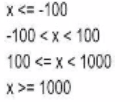
Which of the following alternatives includes correct test values for x. based on equivalence partitioning?
The question is about selecting the correct test values for x based on equivalence partitioning. Equivalence partitioning is a software test design technique that divides the input data of a software unit into partitions of equivalent data from which test cases can be derived. In this case, the given equivalence classes are:
(x \leq -100)
(-100 < x < 100)
(100 \leq x < 1000)
(x \geq 1000)
Option D provides a value from each of these partitions:
For (x \leq -100), it gives -1000.
For (-100 < x < 100), it gives -100 and 100.
For (100 \leq x < 1000), it gives 500.
For (x \geq 1000), it gives 1500.
So, option D covers all four given equivalence classes with appropriate values.
1: ISTQB Foundation Level Syllabus 2018, Version 4.0, p. 38
2: ISTQB Foundation Level Syllabus 2018, Version 4.0, p. 39
: ISTQB Foundation Level Syllabus 2018, Version 4.0, p. 40
A calculator software is used to calculate the result for 5+6.
The user noticed that the result given is 6.
This is an example of;
According to the ISTQB Glossary of Testing Terms, Version 4.0, 2018, page 18, a failure is ''an event in which a component or system does not perform a required function within specified limits''. In this case, the calculator software does not perform the required function of calculating the correct result for 5+6 within the specified limits of accuracy and precision. Therefore, this is an example of a failure.
The other options are incorrect because:
A mistake is ''a human action that produces an incorrect result'' (page 25). A mistake is not an event, but an action, and it may or may not lead to a failure. For example, a mistake could be a typo in the code, a wrong assumption in the design, or a misunderstanding of the requirement.
A fault is ''a defect in a component or system that can cause the component or system to fail to perform its required function'' (page 16). A fault is not an event, but a defect, and it may or may not cause a failure. For example, a fault could be a logical error in the code, a missing specification in the design, or a contradiction in the requirement.
An error is ''the difference between a computed, observed, or measured value or condition and the true, specified, or theoretically correct value or condition'' (page 15). An error is not an event, but a difference, and it may or may not result in a failure. For example, an error could be a rounding error in the calculation, a measurement error in the observation, or a deviation error in the condition.
Reference= ISTQB Glossary of Testing Terms, Version 4.0, 2018, pages 15-18, 25; ISTQB CTFL 4.0 - Sample Exam - Answers, Version 1.1, 2023, Question 96, page 34.
Get access to all 200 verified questions with detailed answers.
Unlock All CTFL_Syll_4.0 Questions