MuleSoft-Platform-Architect-I Exam Questions & Answers
Salesforce Certified MuleSoft Platform Architect • Salesforce
100% money-back guarantee
Sample MuleSoft-Platform-Architect-I Questions
Practice with real exam-style questions, each with the verified correct answer and explanation.
Refer to the exhibit.
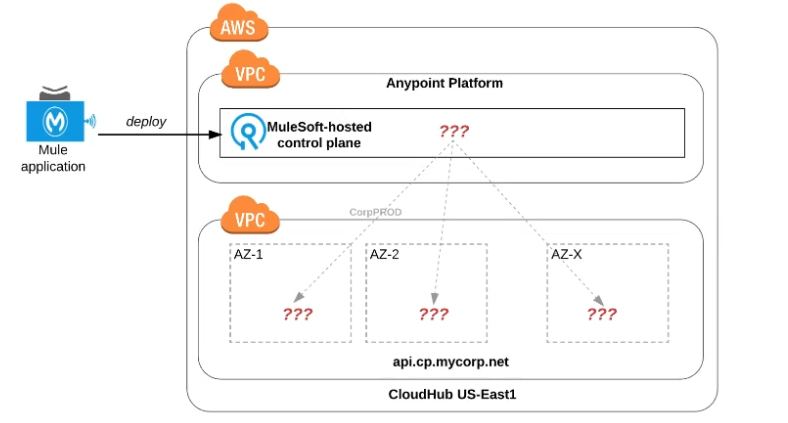
An organization uses one specific CloudHub (AWS) region for all CloudHub deployments.
How are CloudHub workers assigned to availability zones (AZs) when the organization's Mule applications are deployed to CloudHub in that region?
Correct Answe r:Workers are randomly distributed across available AZs within that region.
*****************************************
>>Currently, we only have control to choose which AWS Region to choose but there is no control at all using any configurations or deployment options to decide what Availability Zone (AZ) to assign to what worker.
>>There areNOfixed or implicit rules on platform too w.r.t assignment of AZ to workers based on environment or application.
>>They are completely assigned inrandom. However, cloudhub definitely ensures that HA is achieved by assigning the workers to more than on AZ so that all workers are not assigned to same AZ for same application.
Bottom of Form
Top of Form
What is a key requirement when using an external Identity Provider for Client Management in Anypoint Platform?
https://www.folkstalk.com/2019/11/mulesoft-integration-and-platform.html
Correct Answe r: To invoke OAuth 2.0-protected APIs managed by Anypoint Platform, API clients must submit access tokens issued by that same Identity Provider
*****************************************
>> It is NOT necessary that single sign-on is required to sign in to Anypoint Platform because we are using an external Identity Provider for Client Management
>> It is NOT necessary that all APIs managed by Anypoint Platform must be protected by SAML 2.0 policies because we are using an external Identity Provider for Client Management
>> Not TRUE that the application network must include System APIs that interact with the Identity Provider because we are using an external Identity Provider for Client Management
Only TRUE statement in the given options is - 'To invoke OAuth 2.0-protected APIs managed by Anypoint Platform, API clients must submit access tokens issued by that same Identity Provider'
https://docs.mulesoft.com/api-manager/2.x/external-oauth-2.0-token-validation-policy
https://blogs.mulesoft.com/dev/api-dev/api-security-ways-to-authenticate-and-authorize/
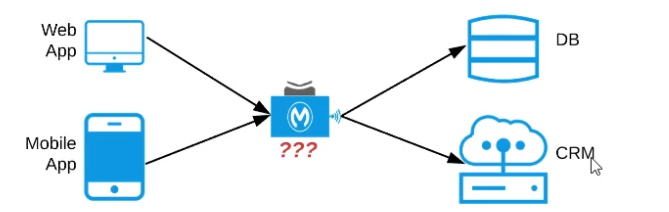
Refer to the exhibit. An organization needs to enable access to their customer data from both a mobile app and a web application, which each need access to common fields as well as certain unique fields.
The data is available partially in a database and partially in a 3rd-party CRM system.
What APIs should be created to best fit these design requirements?
A) A Process API that contains the data required by both the web and mobile apps, allowing these applications to invoke it directly and access the data they need thereby providing the flexibility to add more fields in the future without needing API changes
B) One set of APIs (Experience API, Process API, and System API) for the web app, and another set for the mobile app
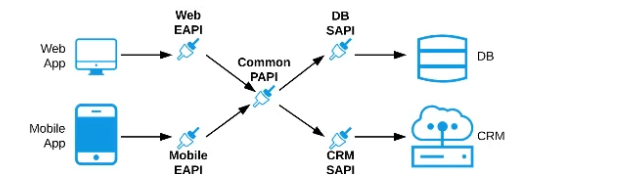
C) Separate Experience APIs for the mobile and web app, but a common Process API that invokes separate System APIs created for the database and CRM system
D) A common Experience API used by both the web and mobile apps, but separate Process APIs for the web and mobile apps that interact with the database and the CRM System
Correct Answe r: Separate Experience APIs for the mobile and web app, but a common Process API that invokes separate System APIs created for the database and CRM system
*****************************************
As per MuleSoft's API-led connectivity:
>> Experience APIs should be built as per each consumer needs and their experience.
>> Process APIs should contain all the orchestration logic to achieve the business functionality.
>> System APIs should be built for each backend system to unlock their data.
An organization is implementing a Quote of the Day API that caches today's quote.
What scenario can use the GoudHub Object Store via the Object Store connector to persist the cache's state?
Correct Answe r: When there is one CloudHub deployment of the API implementation to three CloudHub workers that must share the cache state.
*****************************************
Key details in the scenario:
>> Use the CloudHub Object Store via the Object Store connector
Considering above details:
>> CloudHub Object Stores have one-to-one relationship with CloudHub Mule Applications.
>> We CANNOT use an application's CloudHub Object Store to be shared among multiple Mule applications running in different Regions or Business Groups or Customer-hosted Mule Runtimes by using Object Store connector.
>> If it is really necessary and very badly needed, then Anypoint Platform supports a way by allowing access to CloudHub Object Store of another application using Object Store REST API. But NOT using Object Store connector.
So, the only scenario where we can use the CloudHub Object Store via the Object Store connector to persist the cache's state is when there is one CloudHub deployment of the API implementation to multiple CloudHub workers that must share the cache state.
A set of tests must be performed prior to deploying API implementations to a staging environment. Due to data security and access restrictions, untested APIs cannot be granted access to the backend systems, so instead mocked data must be used for these tests. The amount of available mocked data and its contents is sufficient to entirely test the API implementations with no active connections to the backend systems. What type of tests should be used to incorporate this mocked data?
Correct Answe r: Unit tests (Whitebox)
*****************************************
As per general IT testing practice and MuleSoft recommended practice, Integration and Performance tests should be done on full end to end setup for right evaluation. Which means all end systems should be connected while doing the tests. So, these options are OUT and we are left with Unit Tests and Functional Tests.
As per attached reference documentation from MuleSoft:
Unit Tests - are limited to the code that can be realistically exercised without the need to run it inside Mule itself. So good candidates are Small pieces of modular code, Sub Flows, Custom transformers, Custom components, Custom expression evaluators etc.
Functional Tests - are those that most extensively exercise your application configuration. In these tests, you have the freedom and tools for simulating happy and unhappy paths. You also have the possibility to create stubs for target services and make them success or fail to easily simulate happy and unhappy paths respectively.
As the scenario in the question demands for API implementation to be tested before deployment to Staging and also clearly indicates that there is enough/ sufficient amount of mock data to test the various components of API implementations with no active connections to the backend systems, Unit Tests are the one to be used to incorporate this mocked data.
Get access to all 152 verified questions with detailed answers.
Unlock All MuleSoft-Platform-Architect-I Questions