CIMAPRA17-BA3-1 Exam Questions & Answers
BA3 - Fundamentals of Financial Accounting • CIMA
100% money-back guarantee
About CIMAPRA17-BA3-1 Exam
The CIMAPRA17-BA3-1 (BA3 - Fundamentals of Financial Accounting) certification exam is a critical assessment for professionals seeking to establish a strong foundation in financial accounting principles and practices. This CIMA exam covers essential topics including the accounting equation, financial statements preparation, ledger accounts, trial balance, adjustments, and the principles of double-entry bookkeeping. The BA3 certification validates your ability to understand and apply fundamental accounting concepts used across organizations globally, making it an ideal stepping stone for accountants, finance professionals, and business managers pursuing the CIMA qualification pathway.
Candidates preparing for the CIMAPRA17-BA3-1 exam should leverage updated exam dumps and comprehensive practice tests to maximize their success rates. These resources provide authentic exam scenarios, identify knowledge gaps, and build confidence through repeated exposure to actual test formats and question types. Practice tests simulate real exam conditions, allowing you to manage time effectively and reinforce critical concepts. By utilizing quality study materials and practice exams, candidates can significantly improve their preparation strategy, increase retention of complex accounting principles, and achieve higher scores. Whether you're a first-time test taker or retaking the exam, structured practice resources are invaluable tools for mastering BA3 content and advancing your accounting career.
Exam Topics & Objectives
4-Week Study Plan for CIMAPRA17-BA3-1
Week 1: Foundations and Recording Basics
- Study the 4 fundamental accounting concepts (going concern, accruals, consistency, prudence)
- Review accounting regulations and standards applicable to BA3
- Learn the double-entry bookkeeping principle and accounting equation (Assets = Liabilities + Equity)
- Practice recording simple transactions in T-accounts
- Complete 20 practice questions on accounting principles and basic transaction recording
- Review source documents (invoices, receipts, cheques) and their role in accounting
Week 2: Advanced Transaction Recording
- Master journal entries for sales, purchases, and returns
- Study cash and credit transactions in detail
- Learn discount calculations (trade and cash discounts)
- Practice recording VAT transactions
- Work through bank reconciliation procedures
- Complete 40 practice questions focused on transaction recording
- Attempt 2 full mock scenarios involving multiple transaction types
Week 3: Account Preparation and Trial Balance
- Study the purpose and preparation of trial balance
- Learn adjustment entries (accruals, prepayments, depreciation, bad debts)
- Practice preparing income statements and statements of financial position
- Work through complete accounting cycles from transactions to final accounts
- Study closing entries and transfer to profit and loss accounts
- Complete 30 practice questions on account preparation
- Attempt 3 comprehensive full-cycle accounting scenarios
Week 4: Financial Statement Analysis and Exam Preparation
- Learn ratio analysis (profitability, liquidity, efficiency ratios)
- Study interpretation of financial statement trends
- Practice calculating and analyzing key financial metrics
- Review working capital and cash flow concepts
- Complete 20 practice questions on financial analysis
- Sit 2 full-length mock exams under timed conditions
- Review weak areas identified in mocks and prior week practice
- Conduct final review of all 4 exam sections with emphasis on application questions
Sample CIMAPRA17-BA3-1 Questions
Practice with real exam-style questions. Reveal answers to verify your knowledge.
Goodwill should be shown on the statement of financial position under the following heading:
On 1 April 2006, a company was owed $13,560 by a customer. During the month of April the customer purchased goods for $6,800 and returned goods valued at $1,200. A cheque for $8,480 was received from the customer but was subsequently dishonored by the bank. The balance on the customer's account at the end of the month is:
On 1 January 2001, a company owed a supplier 840.
During the month of January the company purchased goods for 1400 and returned goods valued at 200. A payment of 200 was made towards the outstanding balance. The supplier offered a discount of 5% on purchases.
The balance on the supplier's account at the end of the period is:
Refer to the Exhibit.
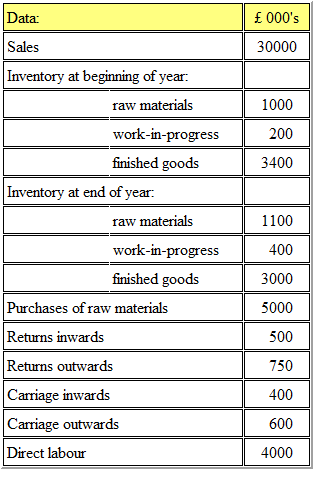
The following information relates to a business at its year end:
The prime cost of goods manufactured during the year is:
Mr UY has just had property P re-valued. Mr UY originally purchased property P for 560,000. It is now worth 780,000.
Which ONE of the following shows how this transaction should be recorded in Mr UY's property account?
Get access to all 393 verified questions with detailed answers.
Unlock All CIMAPRA17-BA3-1 Questions