CIMAPRA19-F03-1 Exam Questions & Answers
F3 Financial Strategy • CIMA
100% money-back guarantee
About CIMAPRA19-F03-1 Exam
The CIMAPRA19-F03-1 exam, commonly known as F3 Financial Strategy, is a critical certification offered by CIMA (Chartered Institute of Management Accountants) for professionals seeking to advance their careers in management accounting and financial planning. This intermediate-level qualification covers essential topics including strategic financial management, investment decisions, and organizational value creation. Candidates pursuing this certification gain comprehensive knowledge in areas such as financial strategy formulation, capital budgeting, risk management, and performance measurement systems. The F3 Financial Strategy exam is ideal for management accountants, finance professionals, and business leaders who want to demonstrate their expertise in developing and implementing effective financial strategies that drive organizational success.
To successfully pass the CIMAPRA19-F03-1 exam, candidates benefit significantly from utilizing updated exam dumps and comprehensive practice tests that mirror the actual test format and difficulty level. These study resources help candidates identify knowledge gaps, build confidence, and master complex financial concepts required for the certification. Practice tests simulate real exam conditions, allowing candidates to manage their time effectively and refine their problem-solving strategies. By combining official study materials with high-quality exam dumps and practice tests, candidates substantially improve their chances of achieving a passing score and obtaining their F3 Financial Strategy certification, ultimately enhancing their professional credentials and career prospects in the competitive accounting and finance industry.
Exam Topics & Objectives
4-Week Study Plan for CIMAPRA19-F03-1
Week 1: Financial Policy Decisions & Sources of Long-Term Funds Foundation
- Study financial policy framework and organizational objectives alignment
- Review dividend policy theories (Miller-Modigliani, clientele effect, signaling theory)
- Analyze capital structure decisions and optimal gearing ratios
- Examine sources of long-term finance: equity, debt, and hybrid instruments
- Compare bond issuance, bank loans, and lease financing options
- Complete practice questions on financing policy selection
Week 2: Business Valuation & Financial Risks
- Master valuation methods: DCF, comparable companies, asset-based approaches
- Study dividend discount models and free cash flow valuation
- Learn enterprise value calculation and price-to-earnings multiples
- Identify types of financial risk: interest rate, liquidity, credit, currency risk
- Analyze operational and systematic risk measurement
- Review hedging strategies and risk mitigation techniques
- Work through valuation case studies and numerical problems
Week 3: Integrated Financial Strategy Scenarios
- Practice integrated cases combining financing, valuation, and risk topics
- Analyze M&A scenarios with valuation and financing implications
- Study working capital management within financial strategy context
- Review financial policy impact on shareholder value
- Examine real-world financial decisions from case study materials
- Complete section-specific mock exam questions (50 questions)
- Identify weak areas for targeted review
Week 4: Comprehensive Revision & Exam Preparation
- Review all financial policy decision frameworks and decision trees
- Consolidate sources of long-term funds comparison matrices
- Revise financial risk identification and quantification methods
- Practice business valuation calculations under time pressure
- Complete full-length mock exam papers (3 attempts minimum)
- Review exam technique and time management strategies
- Memorize key formulas, ratios, and theoretical concepts
- Clarify remaining doubts through focused revision notes
Sample CIMAPRA19-F03-1 Questions
Practice with real exam-style questions. Reveal answers to verify your knowledge.
A manufacturing company based in Country R. where the currency is the R$, has an objective of maintaining an operating profit margin of at least 10% each year
Relevant data:
* The company makes sales to Country S whose currency is the SS It also makes sales to Country T whose currency is the T$ " All purchases are from Country U whose currency is the US.
* The settlement of an transactions is in the currency of the customer or supplier
Which of the following changes would be most likely to help the company achieve its objective?
Company C is a listed company. It is currently considering the acquisition of Company D. The original founder of Company C currently owns 52% of the shares.
Alternative forms of consideration for Company D being considered are as follows:
* Cash payment, financed by new borrowing
* issue of new shares in Company C
Which of the following is an advantage of a cash offer over a share-for exchange from the viewpoint of the original founder of Company C?
A companyfinanced byequity and debt can be valued by discounting:
A company generates and distributes electricity and gas to households and businesses.
Forecast results for the next financial year are as follows:
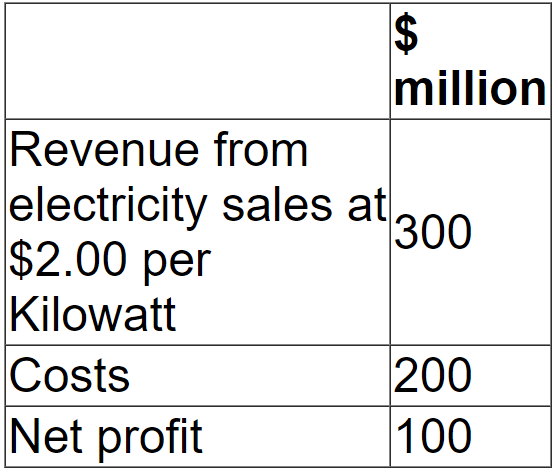
The Industry Regulator has announced a new price cap of $1.50 per Kilowatt.
The company expects this to cause consumption to rise by 10% but costs would remained unaltered.
The price cap is expected to cause the company's net profit to fall to:
Which of the following statements is true of a spin-off (or demerger)?
Get access to all 391 verified questions with detailed answers.
Unlock All CIMAPRA19-F03-1 Questions