CIMAPRA19-F02-1 Exam Questions & Answers
F2 Advanced Financial Reporting • CIMA
100% money-back guarantee
About CIMAPRA19-F02-1 Exam
The CIMAPRA19-F02-1 exam, commonly known as F2 Advanced Financial Reporting, is a critical assessment for professionals pursuing the CIMA chartered accountancy qualification. This advanced-level examination evaluates candidates' expertise in complex financial reporting standards, international accounting principles, and regulatory frameworks essential for senior finance roles. Key topics covered include IFRS compliance, consolidated financial statements, accounting for business combinations, and specialized accounting treatments for various transactions and events. The F2 certification demonstrates mastery of advanced reporting concepts required for strategic financial decision-making in modern organizations.
Finance professionals, senior accountants, and aspiring management accountants should take the CIMAPRA19-F02-1 exam to validate their advanced reporting competencies and progress toward the prestigious CIMA designation. To maximize success rates, candidates benefit significantly from updated exam dumps, comprehensive practice tests, and structured study materials that simulate real exam conditions. These resources help identify knowledge gaps, reinforce complex concepts, and build confidence before the actual assessment. Combining practical experience with quality exam preparation tools ensures candidates thoroughly understand advanced financial reporting principles and achieve their certification goals efficiently.
Exam Topics & Objectives
4-Week Study Plan for CIMAPRA19-F02-1
Week 1: Financing Capital Projects & Financial Reporting Standards Foundation
- Study capital project financing methods: debt, equity, leasing, and hybrid instruments
- Analyze lease accounting under IFRS 16 with practical examples
- Review accounting for borrowing costs under IAS 23
- Understand financial reporting framework: IFRS conceptual framework and regulatory requirements
- Complete 3 practice questions on lease classification and accounting treatment
- Create summary notes on financing decision criteria and impact on financial statements
Week 2: Group Accounts & Consolidation Principles
- Master consolidation procedures under IFRS 10 with focus on control assessment
- Study business combinations and acquisition accounting under IFRS 3
- Learn goodwill recognition, measurement, and impairment testing
- Understand equity accounting for associates under IAS 28
- Review joint arrangements and IFRS 11 classifications
- Work through 4 consolidated financial statement scenarios with intra-group transactions
- Practice elimination of intercompany balances and profits
Week 3: Integrated Reporting & Financial Statement Analysis
- Study integrated reporting framework and six capitals concept
- Understand connectivity between financial and non-financial information disclosure
- Review materiality assessment in integrated reporting context
- Learn ratio analysis techniques: liquidity, profitability, leverage, and efficiency ratios
- Analyze cash flow statements and working capital management
- Study segment reporting requirements under IFRS 8
- Complete 3 full financial statement analysis cases with integrated perspectives
- Practice interpretation of trends and stakeholder communication
Week 4: Comprehensive Revision & Mock Examinations
- Review all four topic areas with integrated scenarios combining multiple standards
- Complete full mock exam 1 (3 hours) under timed conditions
- Review mock exam 1 answers and identify weak areas
- Complete full mock exam 2 (3 hours) under timed conditions
- Study examiner's reports from previous sittings for common errors
- Practice 10 targeted questions covering complex group consolidation with financing decisions
- Review integrated reporting disclosure requirements in real annual reports
- Consolidate all summary notes into quick-reference revision guide
- Final review of key definitions, standards, and calculation methodologies
Sample CIMAPRA19-F02-1 Questions
Practice with real exam-style questions. Reveal answers to verify your knowledge.
Which THREE of the following statements are true in relation to financial assets designated as fair value through profit or loss under IAS 39 Financial Instruments: Recognition andMeasurement?
FG has a weighted average cost of capital of 12% based on its existing:
* level of gearing of 30% (measured as debt/(debt + equity)); and
* business operations.
This would be used as an appropriatediscount factor to assess which of the following significant projects?
Information from the financial statements of an entity for the year to 31 December 20X5:
The gearing ratio calculated as debt/equity and interest cover are:
Which TWOof the following areTRUEin respect of preparing a consolidated statement of cash flows where there has been anacquisition of a subsidiary part way through the year?
KL acquired 2 million $1 equity shares in MN on 18 July 20X0 for $1.65 a share and classified this investment as available for sale (AFS) in accordance with IAS 39 Financial instruments: Recognition andMeasurement.
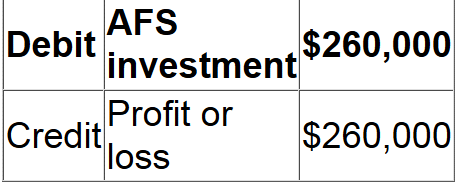
KL paid a 0.5% transaction fee to its broker on this transaction. MN's shares were trading at $1.78 on 31 December 20X0.
Which of the following journals records the subsequent measurement of this investment at 31 December 20X0?
Get access to all 248 verified questions with detailed answers.
Unlock All CIMAPRA19-F02-1 Questions