CIMAPRA19-F01-1 Exam Questions & Answers
F1 Financial Reporting • CIMA
100% money-back guarantee
About CIMAPRA19-F01-1 Exam
The CIMAPRA19-F01-1 (F1 Financial Reporting) certification exam is a fundamental qualification offered by CIMA that validates your expertise in financial reporting principles and practices. This comprehensive exam covers essential topics including financial statement preparation, accounting standards, international financial reporting frameworks, and the regulatory environment governing corporate financial disclosure. Designed for aspiring management accountants and finance professionals, the F1 examination tests your understanding of how organizations communicate financial performance to stakeholders. Candidates pursuing the CIMA Chartered Institute of Management Accountants qualification must successfully complete this foundational exam to progress toward advanced certifications. Whether you're starting your accounting career or seeking to formalize your financial reporting knowledge, mastering the F1 exam demonstrates your competency in this critical business domain.
To effectively prepare for the CIMAPRA19-F01-1 exam, candidates benefit significantly from utilizing updated exam dumps and comprehensive practice tests that mirror the actual test format and difficulty level. These study resources help identify knowledge gaps, reinforce complex concepts, and build confidence through repetitive problem-solving. Practice tests simulate real exam conditions, allowing you to manage time effectively and familiarize yourself with question types you'll encounter. Updated exam dumps provide insight into frequently tested topics and current industry standards relevant to financial reporting. By combining traditional study methods with quality practice materials, candidates can optimize their preparation strategy and increase their likelihood of achieving a passing score on the first attempt.
Exam Topics & Objectives
4-Week Study Plan for CIMAPRA19-F01-1
Week 1: Regulatory Environment & Financial Statement Foundations
- Study IASB framework and IFRS standards overview for F1 Financial Reporting
- Understand the regulatory bodies: IASB, IFRS IC, and their role in financial reporting standards
- Learn the conceptual framework: qualitative characteristics of financial information (relevance, faithful representation, comparability, understandability, timeliness)
- Review the objective of financial reporting and user needs
- Study the elements of financial statements: assets, liabilities, equity, income, and expenses
- Complete practice questions on regulatory concepts and framework principles
- Create summary notes on key regulatory requirements for CIMAPRA19-F01-1
Week 2: Financial Statements & Principles of Taxation
- Examine the complete set of financial statements: statement of financial position, statement of comprehensive income, statement of changes in equity, statement of cash flows, and notes
- Study recognition and measurement criteria for financial statement items
- Learn accounting treatments for transactions: revenue recognition (IFRS 15), inventory valuation (IAS 2), depreciation (IAS 16)
- Understand basic tax principles: income tax, capital gains tax, VAT/GST implications
- Study tax allowances, reliefs, and the impact of taxation on business decisions
- Analyze tax planning considerations and compliance requirements
- Work through integrated case studies combining financial statements with tax calculations
- Complete 30+ practice questions on financial statements and taxation
Week 3: Managing Cash & Working Capital
- Study working capital management: current assets and current liabilities optimization
- Learn cash conversion cycle calculation and management techniques
- Understand receivables management: credit policies, collection procedures, and bad debt provisions
- Review inventory management: holding costs, ordering costs, and economic order quantity (EOQ)
- Study payables management and supplier relationship optimization
- Analyze cash flow forecasting and cash budgeting techniques
- Learn liquidity ratios: current ratio, quick ratio, and working capital metrics
- Study short-term funding options and their impact on financial statements
- Complete scenario-based questions on working capital decisions
Week 4: Comprehensive Revision & Exam Preparation
- Review all four main topics through topic-by-topic revision guides
- Complete full-length mock exams under timed conditions (3 hours)
- Analyze mock exam results and identify weak areas for targeted review
- Practice exam-style questions from each topic: regulatory (15%), financial statements (40%), taxation (20%), cash/working capital (25%)
- Review common pitfalls and frequently tested concepts in CIMAPRA19-F01-1
- Study actual CIMA case study examples and past exam scenarios
- Create revision flashcards for key definitions, formulas, and IFRS standards
- Conduct peer review or tutoring session on difficult concepts
- Final review of exam technique: time management, question reading strategies, and answer structuring
- Verify understanding of integrated scenarios combining multiple topics
Sample CIMAPRA19-F01-1 Questions
Practice with real exam-style questions. Reveal answers to verify your knowledge.
XYZ operates in Country P where the tax rules state entertaining costs and accounting depreciation are disallowable for tax purposes.
In year ending 31 March 20X4, XYZ made an accounting profit of $240,000.
Profit included $14,500 of entertaining costs and $5,000 of income exempt from taxation.
XYZ has plant and machinery with accounting depreciation amounting to $26,300 and tax depreciation amounting to $35,200.
Calculate the taxable profit for the year ended 31 March 20X4.
XYZ operates in Country A where tax rules state that entertaining costs and donations to political parties are disallowable for tax purposes.
XYZ calculated both its accounting and taxable profits for the year ended 31 December 20X2 after deducting $10,000 of entertaining costs.
It is considering what impact the ruling that "entertaining costs are disallowable for tax purposes" will have on its two profit figures.
Which of the following correctly states the impact of the ruling on the profits already calculated?
The International Accounting Standards Board's "The Conceptual Framework for Financial Reporting" identifies fundamental and enhancing qualitative characteristics of financial statements.
Which of the following is included within the fundamental characteristics?
In Country X, trading losses in any year can be carried back and set off against trading profits in the previous year, with any unrelieved losses carried forward to set against the first available trade profits in future years.
GH had the following taxable profits and losses in years 20X1 to 20X4:
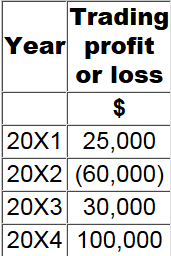
What are the taxable profits for 20X4, assuming the most efficient use of the loss is made?
DEF is considering introducing a Pay-As-You-Earn (PAYE) system but unsure of the advantages of using it.
Which of the following statements are advantages from the employees perspective of an entity using a PAYE system for collecting taxes from employees.
Select ALL that apply.
Get access to all 177 verified questions with detailed answers.
Unlock All CIMAPRA19-F01-1 Questions