300-445 Exam Questions & Answers
Designing and Implementing Enterprise Network Assurance • Cisco
100% money-back guarantee
Sample 300-445 Questions
Practice with real exam-style questions, each with the verified correct answer and explanation.
The Endpoint stopped appearing online after it was moved to another network. The customer reviewed the endpoint logs but did not identify anything suspicious. The customer also confirmed that the endpoint was online on the old network, and the new network is fully operational. Other endpoints that were moved to the new network are also online. Since the new network is small, the admin is using static IP assignment. What is the best way to bring the endpoint online?
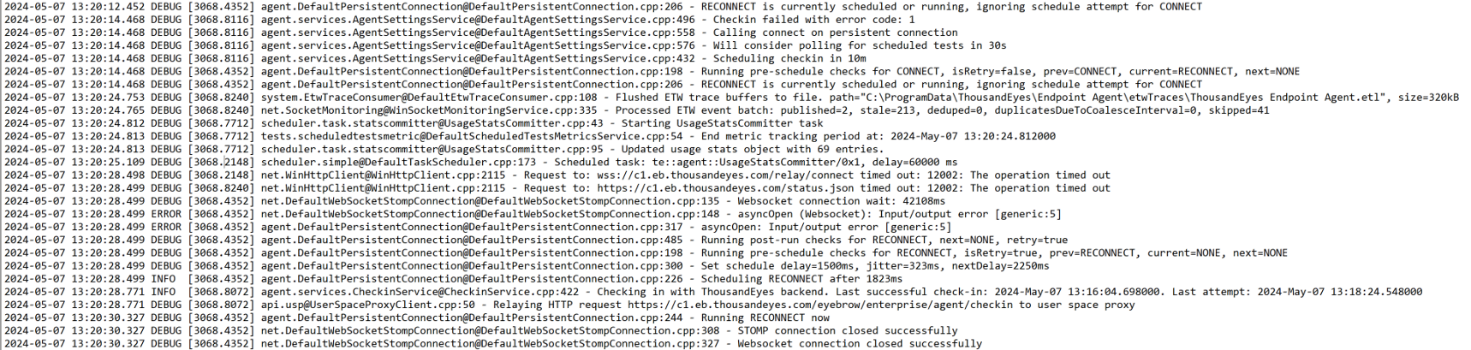
In the Designing and Implementing Enterprise Network Assurance (300-445 ENNA) curriculum, troubleshooting endpoint connectivity requires a systematic analysis of local device logs and network environment changes. According to the log message provided in Exhibit there was a specific timeout error when the agent attempted to reach the ThousandEyes backend. The logs explicitly state: Request to: wss://c1.eb.thousandeyes.com/relay/connect timed out: 12002: The operation timed out.
Since the endpoint was relocated to a new network utilizing static IP assignment, and other endpoints on the same network are functioning correctly, the issue is highly localized to this specific device's configuration. In a static IP environment, human error during the manual entry of the IP address, subnet mask, default gateway, or DNS server is a common root cause of connectivity failure. If the gateway is incorrect, the agent cannot reach the internet; if the DNS is incorrect, it cannot resolve c1.eb.thousandeyes.com. Therefore, the best way to bring the endpoint online is to verify the accuracy of the IP settings and test direct connectivity to the ThousandEyes relay URL.
The alternative options do not address the technical evidence found in the logs:
Option A: Moving the device back is a regressive step that does not resolve the need for the device to function in its new location.
Option B: Reinstalling software is a 'brute force' method that rarely fixes underlying network-layer misconfigurations like an incorrect static IP.
Option C: A timeout error (12002) indicates a persistent connectivity blockage that will not resolve itself without administrative intervention.
Checking the static IP credentials ensures the device has a valid path to the internet to establish its secure websocket (WSS) connection to the ThousandEyes platform.
An architect needs to measure end-user experience for internal web applications and SaaS products.20 Which ThousandEyes agent should be deployed for this purpose?
In the context of Designing and Implementing Enterprise Network Assurance (300-445 ENNA), measuring the 'lived experience' of an end-user requires data collection from the actual device being used to access the services. Unlike server-side or infrastructure-side monitoring, user experience (UX) monitoring must account for local variables like Wi-Fi signal quality, CPU/memory usage, and browser-level pe21rformance.
The Endpoint Agent (Option D) is the correct choice for this architecture. It is a lightweight software service installed directly on Windows or macOS workstations, as well as RoomOS devices. The Endpoint Agent provides a dual-monitoring approach: Real User Monitoring (RUM) and Scheduled Synthetic Tests.24 RUM captures actual browser sessions to SaaS (e.g., Salesforce, Microsoft 365) or internal apps, providing a 'Experience Score' and a detailed waterfall view of page load components.25 Simultaneously, the agent can run background synthetic network tests to measure latency and path visualization from the user's specific location, whether they are in a branch office, at home on a VPN, or in a coffee shop.
Comparing other agents:
Enterprise Agents (Option B) can simulate a user at a branch office, but they cannot provide insight into the specific health of an individual's laptop or their unique Wi-Fi environment.
Cloud Agents (Option C) are entirely outside the user's network and cannot measure the performance of internal web applications or the 'last mile' connectivity of the employee.
Synthetic Agent (Option A) remains a distractor term.
By deploying Endpoint Agents, the architect ensures they have granular, contextual data that correlates application performance directly with the user's device and local network environment.
Refer to Exhibit:
A network engineer is deploying a Cisco ThousandEyes agent to monitor the network for a SaaS application without affecting the performance of the employee endpoints. Which ThousandEyes agent must be deployed to obtain the network metrics from branch A?
In the framework of Designing and Implementing Enterprise Network Assurance (300-445 ENNA), selecting the appropriate ThousandEyes agent type is critical to balancing visibility requirements with infrastructure constraints. For Branch A, the primary objective is to gain network-layer metrics (such as latency, packet loss, and jitter) and path visualization for a SaaS application while strictly avoiding any performance impact on employee endpoints.
The Enterprise Agent (Option C) is the correct choice because it is designed for 'inside-out' monitoring from within the corporate network environment. These agents are lightweight software probes that can be deployed on existing network infrastructure, such as Cisco Catalyst 9300/9400 switches or Catalyst 8000 Edge Platforms, using Docker containers or virtual machines. By hosting the agent on the branch router or a dedicated local server, the engineer can execute synthetic tests to the SaaS provider's destination. This approach provides the necessary network vantage point from Branch A without requiring any software installation or resource consumption on the individual employee workstations (endpoints).
Other agent types do not satisfy the specific constraints of this scenario:
Endpoint Agents are installed directly on user devices (Windows/macOS) to provide 'last-mile' visibility. However, they use the endpoint's CPU and memory, which contradicts the requirement to not affect endpoint performance.
Cloud Agents are maintained by Cisco in global ISP data centers. While they provide 'outside-in' visibility, they cannot capture internal branch network characteristics or the specific path from Branch A's internal local area network.
Application Agent is a non-standard term and does not exist as a standalone agent type within the ThousandEyes architecture.
Therefore, deploying an Enterprise Agent within the branch infrastructure ensures that the network engineer obtains high-fidelity network metrics while keeping employee devices entirely unburdened.
Introduction to ThousandEyes
This video provides an essential overview of how ThousandEyes agents function within a CCNP-level enterprise network assurance strategy.
Refer to the exhibit.
An engineer must use Cisco ThousandEyes testing to monitor their Cisco Catalyst SD-WAN fabric. Which SD-WAN component is being monitored by ThousandEyes?
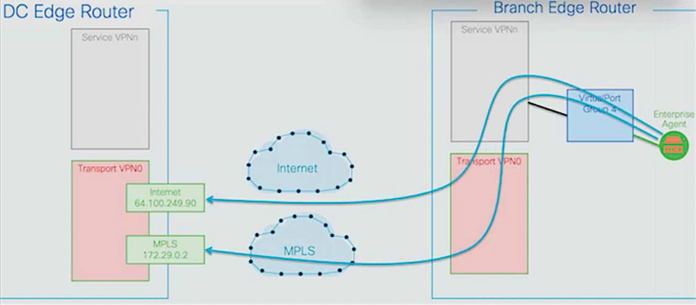
In the Designing and Implementing Enterprise Network Assurance (300-445 ENNA) curriculum, understanding the visibility gap between the SD-WAN overlay and the transport underlay is a core competency. The provided exhibit illustrates a ThousandEyes Enterprise Agent deployed on a Branch Edge Router performing tests across two distinct paths: Internet (reaching a destination at 64.100.249.90) and MPLS (reaching a destination at 172.29.0.2).
According to the ENNA architecture guidelines, ThousandEyes is primarily utilized to provide hop-by-hop visibility into the underlay network. While SD-WAN controllers like vManage provide native monitoring for the overlay---the logical IPsec tunnels (Option B) that form the SD-WAN fabric---they often lack granular visibility into the physical service provider paths (the underlay) that carry those tunnels. The exhibit specifically highlights the agent probing the transport networks (Transport VPN0) directly, bypassing the overlay tunnels to measure the raw performance of the ISP and MPLS circuits.
By monitoring the underlay (Option A), the engineer can identify if high latency or packet loss is caused by a specific hop within the service provider's infrastructure or at a peering point. This 'underlay visibility' is critical for troubleshooting SD-WAN performance issues where the overlay may report a tunnel down, but the root cause lies in a BGP routing change or physical fiber cut in the provider network. ThousandEyes Enterprise Agents, natively integrated into Catalyst 8000 and ISR 4000 platforms, allow for this persistent underlay monitoring without additional hardware.
Overlay (Option C): While ThousandEyes can monitor overlay performance, the exhibit's focus on the raw IP addresses (Internet and MPLS) in the transport VPN indicates an underlay test.
IPsec/GRE Tunnels (Options B & D): These represent the transport mechanisms of the overlay. ThousandEyes probes the path under these tunnels to ensure the transport health is sufficient to support the fabric.
SNMP data indicates that a wireless access point is experiencing high channel utilization and increased retransmissions. What optimization would you recommend to improve voice call quality for users on this access point?
In wireless network assurance, high channel utilization and increased retransmissions are clear indicators of RF interference or over-subscription. Retransmissions are particularly damaging to voice call quality because they introduce significant jitter and late-arrival packet loss that the jitter buffer cannot overcome.
The recommended optimization is to change the access point to a different, less congested channel (Option B). This directly reduces the competition for airtime (Channel Utilization) and the likelihood of collisions from neighboring access points (Co-Channel Interference), which in turn lowers the retransmission rate. Modern wireless controllers using Radio Resource Management (RRM) often automate this, but a manual adjustment based on SNMP telemetry is a valid operational fix.
Other options are technically flawed:
Option A: Increasing transmit power often increases interference and channel utilization for surrounding cells, making the problem worse for everyone.
Option C: Disabling all non-voice traffic is an extreme measure that is rarely feasible in a real business environment.
Option D: Admission control limits the number of users but doesn't solve the underlying issue of poor channel health for those already connected.
Get access to all 68 verified questions with detailed answers.
Unlock All 300-445 Questions