300-730 Exam Questions & Answers
Implementing Secure Solutions with Virtual Private Networks • Cisco
100% money-back guarantee
About 300-730 Exam
The Cisco 300-730 certification exam, also known as Implementing Secure Solutions with Virtual Private Networks (SVPN), is a critical credential for cybersecurity professionals seeking to validate their expertise in VPN technologies and secure network implementations. This intermediate-level exam covers essential topics including VPN fundamentals, site-to-site VPN configuration, remote access VPN solutions, VPN security protocols, and troubleshooting methodologies. Candidates will be tested on their ability to implement and manage secure VPN architectures using Cisco technologies, making this certification invaluable for network administrators, security engineers, and IT professionals looking to advance their careers in enterprise security.
Network professionals with foundational knowledge of Cisco networking concepts should consider taking the 300-730 exam to demonstrate their proficiency in designing and deploying secure VPN solutions. To maximize exam success, candidates benefit significantly from utilizing updated exam dumps and comprehensive practice tests that mirror the actual exam format and difficulty level. These resources help identify knowledge gaps, reinforce critical concepts, and build confidence before attempting the certification. By combining hands-on lab experience with structured study materials and practice assessments, candidates can effectively prepare for the 300-730 exam and achieve their professional development goals in cybersecurity and network security specialization.
Exam Topics & Objectives
4-Week Study Plan for 300-730
Week 1: VPN Fundamentals & Site-to-Site Basics
- Review IPsec protocol stack: ESP, AH, and IKE phases
- Study VPN terminology: tunnel mode vs transport mode, encryption algorithms (AES, 3DES), hashing (MD5, SHA)
- Configure basic site-to-site VPN on Cisco ASA using CLI: define crypto maps and access lists
- Set up IKEv1 phase 1 and phase 2 parameters for router-to-router VPN
- Practice ASDM VPN wizard for site-to-site tunnel establishment
- Understand VPN topologies: hub-and-spoke, mesh, and hybrid designs
- Complete 3 hands-on labs on GNS3 or Cisco DevNet sandbox with basic IPsec tunnels
Week 2: Advanced Site-to-Site VPNs & Remote Access Foundations
- Configure dynamic crypto maps and reverse route injection (RRI)
- Implement GRE over IPsec tunnels on routers
- Study DPD (Dead Peer Detection) and keepalive mechanisms
- Configure IKEv2 phase 1 and phase 2 with stronger algorithms
- Review remote access VPN components: RADIUS, LDAP, certificate-based authentication
- Set up Cisco AnyConnect SSL VPN profiles in ASDM
- Configure split tunneling and always-on VPN policies
- Lab: Deploy multi-site VPN with failover using backup tunnels
Week 3: Remote Access VPNs & Troubleshooting Deep Dive
- Configure clientless SSL VPN (portal and bookmark lists) on ASA
- Set up AnyConnect with certificate-based and pre-shared key authentication
- Implement group policies with bandwidth limits and access lists
- Configure RADIUS authentication for remote access users
- Study ASDM monitoring: VPN statistics, tunnel status, and session monitoring
- Use CLI commands: show crypto ipsec sa, show crypto ikev1 sa, show vpn-sessiondb
- Analyze packet captures in Wireshark for IKE negotiation and ESP traffic
- Practice troubleshooting common issues: Phase 1 failures, Phase 2 mismatches, NAT-T problems
- Lab: Debug and resolve 5 simulated VPN connectivity issues
Week 4: Secure Communications Architecture & Exam Prep
- Design VPN solutions for different security requirements and topologies
- Study DMZ architecture integration with VPN access controls
- Implement encryption policies and data loss prevention (DLP) with VPN
- Configure QoS for VPN traffic and bandwidth management
- Review redundancy and high availability: active-active and active-passive failover
- Study compliance requirements: FIPS 140-2, Suite B cryptography
- Use ASDM for comprehensive VPN monitoring and reporting
- Troubleshoot using syslog, debug commands, and ASDM logging
- Review packet flow through ASA with VPN: pre-encryption, encryption, post-encryption
- Take 2 full-length practice exams (300-730 mock tests)
- Review weak areas and re-study specific topics based on practice exam results
Sample 300-730 Questions
Practice with real exam-style questions. Reveal answers to verify your knowledge.
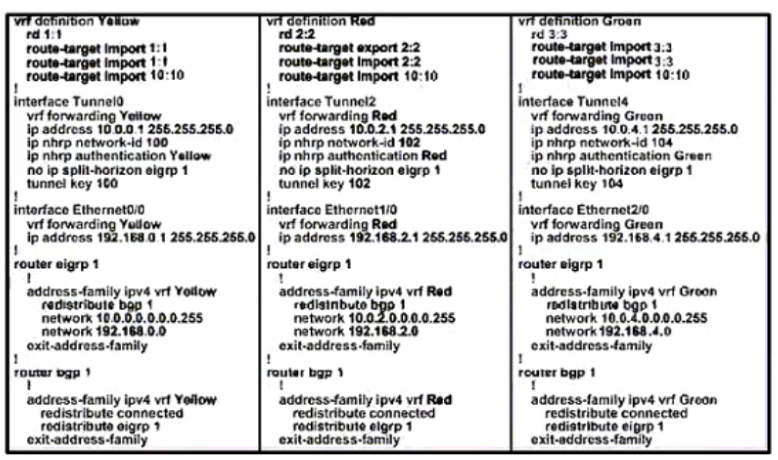
Refer to the exhibit.

Based on the configuration output, what is the VPN technology?
An administrator is designing a VPN with a partner's non-Cisco VPN solution. The partner's VPN device will negotiate an IKEv2 tunnel that will only encrypt subnets 192.168.0.0/24 going to 10.0.0.0/24. Which technology must be used to meet these requirements?
An engineer notices that while an employee is connected remotely, all traffic is being routed to the corporate network. Which split-tunnel policy allows a remote client to use their local provider for Internet access when working from home?
Refer to the exhibit.
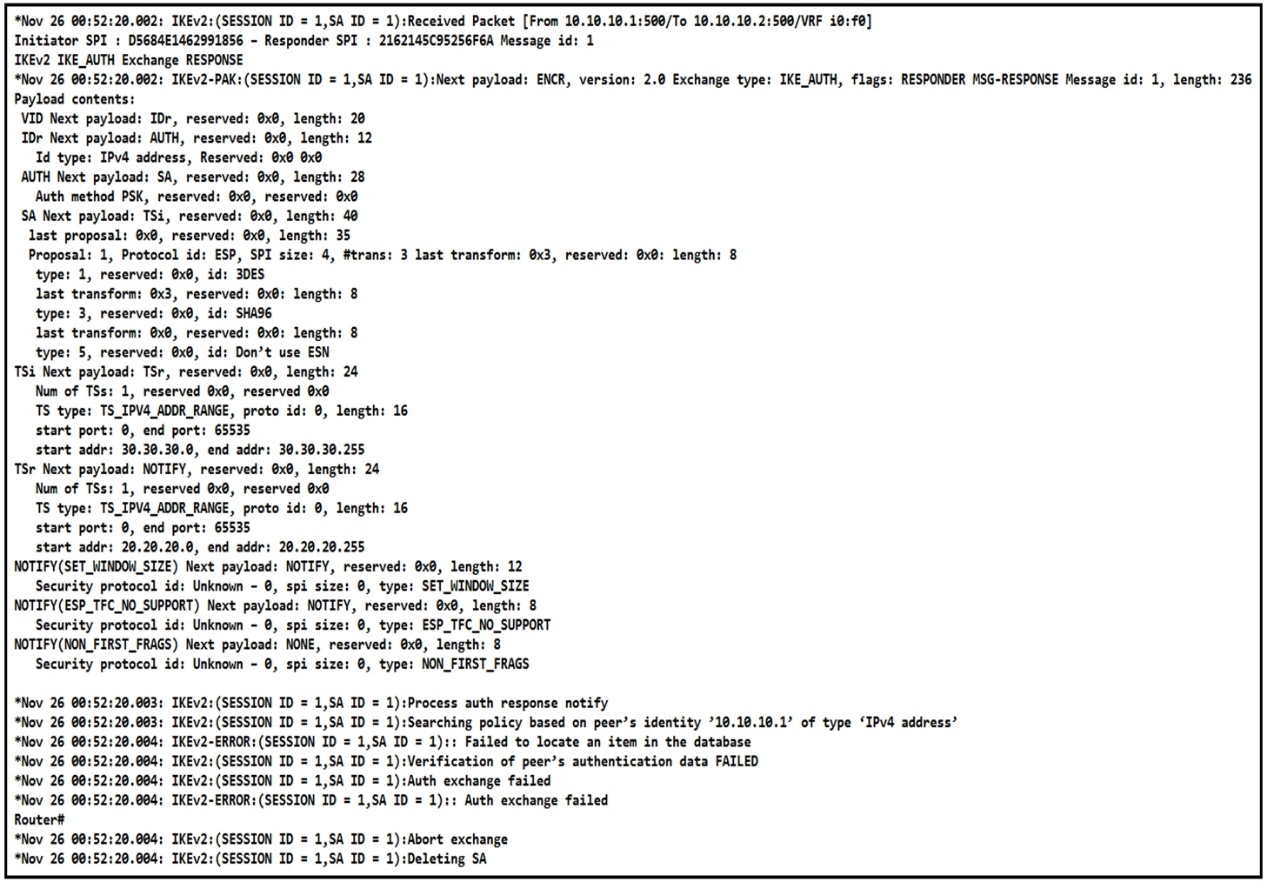
The IKEv2 site-to-site VPN tunnel between two routers is down. Based on the debug output, which type of mismatch is the problem?
What must be configured in a FlexVPN deployment to allow for direct communication between spokes connected to different hubs?
Get access to all 175 verified questions with detailed answers.
Unlock All 300-730 Questions