Limited-Time Offer: Enjoy 50% Savings! - Ends In 0d 00h 00m 00s Coupon code: 50OFF
Free Exam Questions

ATM Exam Questions & Answers

Advanced Test Manager  •  ISTQB

64 Questions 90 min Updated Jul 2026 99% Pass Rate
Get Full Access

100% money-back guarantee

About ATM Exam

The ISTQB Advanced Test Manager (ATM) certification is a prestigious credential for experienced testing professionals seeking to advance their careers in software quality assurance. This advanced-level exam validates expertise in test management, leadership, and strategic planning within QA environments. Key topics covered include test planning and estimation, risk management, test team organization, communication strategies, and metrics-driven decision making. The ATM certification is ideal for test managers, QA leads, and senior testing professionals who want to demonstrate mastery of test management principles and enhance their organizational value. With the increasing complexity of software development, employers actively seek ATM-certified professionals capable of managing large-scale testing initiatives and leading high-performing QA teams.

Preparing for the ATM certification exam requires comprehensive study materials and practical experience. Updated exam dumps and practice tests are invaluable resources that help candidates familiarize themselves with the actual exam format, question types, and time management requirements. Quality practice tests simulate real exam conditions, allowing candidates to identify knowledge gaps and focus their study efforts on challenging areas. By combining official ISTQB study guides with reliable exam dumps and practice tests, candidates significantly increase their chances of passing on the first attempt. These preparation tools enable professionals to confidently validate their test management expertise while maintaining current industry knowledge and best practices in software testing.

Exam Topics & Objectives

1. Testing Process
2. Test Management
3. Reviews
4. Defect Management
5. Improving the Testing Process
6. Test Tools and Automation
7. People Skills – Team Composition

4-Week Study Plan for ATM

Week 1: Foundation & Testing Process

  • Study Testing Process fundamentals: test planning, design, execution, and closure phases
  • Review ISTQB ATM syllabus sections 1.1-1.3 on test process models and activities
  • Create mind map connecting testing process phases to management activities
  • Complete practice questions on test process lifecycle (20 questions minimum)
  • Document key terminology: test strategy, test plan, test case, test execution
  • Review case studies showing testing process in different organizational contexts

Week 2: Test Management & Reviews Core Concepts

  • Study Test Management section 2: objectives, activities, and responsibilities
  • Focus on test planning, monitoring, control, and completion activities
  • Learn Reviews section 3: review process, roles, and effectiveness metrics
  • Practice creating test plans and test monitoring dashboards
  • Complete 30 practice questions on test management and reviews combined
  • Study metrics: test coverage, defect density, schedule variance
  • Review examples of review checklists and defect detection in reviews

Week 3: Defect Management & Process Improvement

  • Study Defect Management section 4: defect lifecycle, classification, and reporting
  • Learn defect severity and priority assignment criteria
  • Study root cause analysis and defect prevention techniques
  • Review Improving the Testing Process section 5: maturity models and continuous improvement
  • Practice creating defect reports with proper documentation
  • Complete 40 practice questions covering defect management and improvement
  • Analyze case studies on process improvement initiatives
  • Study metrics for defect analysis and process effectiveness

Week 4: Test Tools, Automation & People Skills

  • Study Test Tools and Automation section 6: tool selection, implementation, and ROI
  • Learn automation framework types and when to automate vs manual testing
  • Review tool categories: test execution, management, performance, defect tracking
  • Study People Skills and Team Composition section 7: roles, skills, team structure
  • Learn communication, conflict resolution, and team dynamics for test managers
  • Complete 50 mixed practice questions from all seven domains
  • Take 2 full-length practice exams (120 questions each) under timed conditions
  • Review weak areas and retake targeted practice questions
  • Study real-world scenarios combining multiple domains

Sample ATM Questions

Practice with real exam-style questions. Reveal answers to verify your knowledge.

Q1 MultipleChoice

Which of the following statements best describes an appropriate approach for managing exploratory testing?

Number of correct responses: 1

K2 1 credit

Q2 MultipleChoice

In the test strategy document your organization declares:

- To adopt a V-model development lifecycle, with three formal levels of testing. unit, integration and system testing

- To use a blended risk-based and regression-averse testing strategy for each level of testing The following is an excerpt of the ''approach'' section for the system test plan document of a new project:

''Testing will only use manual tests. Due to the short period of time for test execution, the following activities will be performed in parallel with test execution: Test planning, test analysis and test design.

Basic metrics will be taken for test effort (i.e. person-hours), test cases executed (passed/failed), and incidents (no more metrics, such as code coverage, will be collected).'' In the system test plan, no deviations from the test strategy are described. Based only on the given information, which of the following statements is true?

K4 3 credits

Q3 MultipleChoice

Which of the following statements describing how identified product quality risks should be mitigated and managed, is true?

K2 1 credit

Q4 MultipleChoice

Your test team consists of four members (Mary, Bob, Mark, Dave) with different interpersonal skills. The following skills assessment spreadsheet shows the characteristics of the team members with respect to a list of interpersonal-skills (for each characteristic only the member with the highest level of that characteristic is indicated and marked with 'X'):
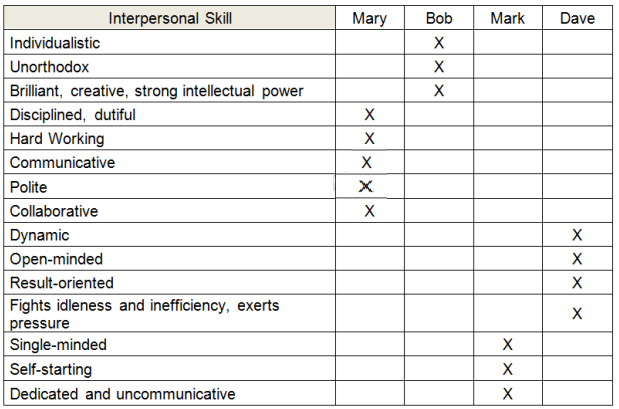
On the next project a member of your test team will have to perform some routine tasks requiring collaboration with other teams. Who in your test team would you expect to be most suitable at doing these tasks? K4 3 credits

Q5 MultipleChoice

Assume you are currently working on a project developing a system where functional

requirements are very well specified. Unfortunately non-functional requirements do almost not exist.

You are the Test Manager. You have to choose a technique for test selection that allows testing of non-functional characteristics, especially reliability.

Which of the following techniques for test selection do you expect being most useful in this scenario?

K2 1 credit

Get access to all 64 verified questions with detailed answers.

Unlock All ATM Questions

Frequently Asked Questions

To take the ATM exam, you must hold a valid ISTQB Certified Tester Foundation Level (CTFL) certification or equivalent. Additionally, you should have at least 5 years of professional software testing experience, with a minimum of 3 years in a test management role.

The ATM exam consists of 8 open-ended questions to be completed in 360 minutes (6 hours). You need to achieve a minimum score of 65% to pass the exam, with answers typically evaluated by certified assessors based on detailed marking schemes.

The ATM exam covers key areas including test strategy and planning, test management processes, test team management, risk-based testing, test metrics and measurement, and test execution and reporting. It also includes practical scenario-based questions that require applying test management concepts to real-world situations.

There is typically no mandatory waiting period between attempts, allowing you to retake the exam as soon as you feel ready. However, you will need to pay the exam fee for each attempt, and it is recommended to study additional materials before retrying to improve your chances of success.

ISTQB Advanced Level certifications, including ATM, are valid for 3 years from the date of passing the exam. After 3 years, you must renew your certification by either retaking the exam or earning continuing education credits to maintain your certified status.
Exam Details
  • Exam CodeATM
  • VendorISTQB
  • Total Questions64
  • Duration90 min
  • LanguageEnglish
  • Last UpdatedJul 19, 2026
4.9/5

Pass ATM First Time

Get all 64 exam questions with verified answers and 90-day free updates.

Buy Now & Pass
  • PDF + Practice Test Bundle
  • 90-Day Free Updates
  • 100% Money-Back Guarantee
  • Instant Download
  • 24/7 Customer Support
99% Pass Rate Trusted by 50,000+ IT professionals