CTAL-TTA Exam Questions & Answers
Certified Tester Advanced Level Technical Test Analyst • ISTQB
100% money-back guarantee
Sample CTAL-TTA Questions
Practice with real exam-style questions, each with the verified correct answer and explanation.
The last release of a hotel booking website resulted in poor system performance when hotel searches reached peak volumes. To address these problems in the forthcoming release, changes to the system architecture are to be implemented as follows:
Change 1 - Provision of a single Internet service using multiple servers, rather than a single server, to maximize throughput and minimize response time during peak volumes
Change 2 - Prevention of unnecessary database calls for objects that were not immediately needed by the calling applications. Achieved by not automatically creating database connections at the start of processing, instead only just before the data is required.
The system architecture document has been drafted and as Technical Test Analyst you have been invited to participate in its review. Which of the following review checklist items is MOST likely to identify any defects in the proposed system architecture for Change 1?
Analysis:
For Change 1, which involves using multiple servers to maximize throughput and minimize response time, the key concern is how the load is distributed across these servers.
B . Load balancing:
Load balancing is the process of distributing network or application traffic across multiple servers to ensure no single server becomes overwhelmed. It is crucial for maximizing throughput and minimizing response times, particularly during peak volumes.
Explanation of Incorrect Options:
A . Connection pooling:
This is related to managing database connections efficiently but is not directly relevant to distributing web server traffic.
C . Distributed processing:
This refers to dividing processing tasks across multiple processors or machines but is not specific to managing web server load.
D . Caching:
Caching helps improve performance by storing frequently accessed data in memory, reducing the need to retrieve it from the database, but it does not address load distribution across servers.
The ISTQB CTAL-TTA syllabus and standard practices in reviewing system architecture emphasize the importance of load balancing for managing server traffic and ensuring optimal performance during peak loads.
Sources:
ISTQB-CTAL-TTA Syllabus
General knowledge on system architecture and load balancing.
A component has been analysed during a risk-assessment and rated as highly critical. Which of the following white-box test techniques provides the highest level of coverage and could therefore be used to test this component?
Modified condition/decision testing (MC/DC) provides a higher level of coverage compared to other white-box testing techniques because it requires each condition in a decision to be shown to independently affect that decision's outcome. It is more rigorous than both decision testing (which only requires each decision's possible outcomes to be tested) and statement testing (which requires only each executable statement to be executed). Therefore, for a highly critical component, MC/DC is more appropriate as it ensures a more thorough assessment of the logic in the software component.
Consider the pseudo code for the Answer program:
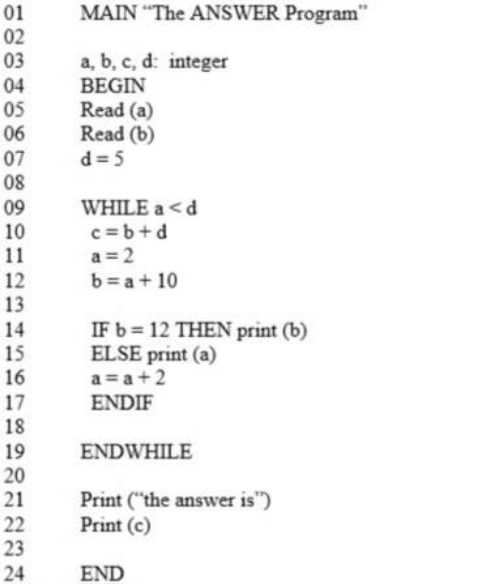
Which of the following statements about the Answer program BEST describes the control flow anomalies to be found in the program?
The provided pseudo code for the Answer program shows a WHILE loop that will always execute because the condition for the loop to terminate (a >= d) is never met within the loop's body. This results in an infinite loop. Additionally, since the value of 'b' is initialized with 'a + 10' and 'a' starts from a value that is read and then set to 2, 'b' will never be equal to 12. Therefore, the 'THEN' branch of the IF statement, which includes 'print(b)', is unreachable. These are control flow anomalies because they represent logic in the code that will not function as presumably intended.
Given the following code:
If x > y and z = 3 statement!
elseif z = 4 statement
endif;
What is the minimum number of tests needed to achieve 100% decision coverage?
To achieve 100% decision coverage, you must ensure every decision in the code has been evaluated both to true and false. Given the code:
If x > y and z = 3 statement1 elseif z = 4 statement2 endif;
Two tests are required:
Test 1: Set x > y true and z = 3 to evaluate the first decision as true and execute statement1.
Test 2: Set z = 4 (ensuring the first condition x > y and z = 3 evaluates to false) to evaluate the elseif condition as true and execute statement2.
This testing ensures that both branches of the decision have been evaluated.
A unit test should be isolated Which option correctly describes the meaning of 'isolated' as a characteristic of a unit test?
SELECT ONE OPTION
Whenever it is run under the same conditions, it should produce the same results.
The term 'isolated' as a characteristic of a unit test means that it should test only the code for which it was originally written. This ensures that the unit test is focused, minimizes dependencies on other parts of the codebase, and errors can be traced back to specific units without ambiguity .
Get access to all 175 verified questions with detailed answers.
Unlock All CTAL-TTA Questions