CTAL-TM Exam Questions & Answers
Certified Tester Advanced Level Test Management v3.0 • ISTQB
100% money-back guarantee
Sample CTAL-TM Questions
Practice with real exam-style questions, each with the verified correct answer and explanation.
What test process is included as part of TPI Next? [1]
According to TPI Next, the test process consists of four main phases: Test Strategy, Test Preparation, Test Execution and Test Completion. Each phase has several key areas that describe the activities and tasks involved in the phase. One of the key areas in the Test Preparation phase is Test Environment, which covers the identification, specification, realization and maintenance of the test environment. The test environment includes the hardware, software, network, data and tools that are required to perform the testing activities. The test environment should be aligned with the test objectives and the system under test, and should be managed throughout the test process.TPI NextTPI Next bookReference:
Test Process Improvement (TPI) | TMap
TPI NEXT | TMap
Test Analysts are doing test design for a change request to an insurance comparison system. The system provides car insurance quotations, using data input by the user.
The change request states:-
Drivers must be aged between 17 to 85 years inclusive to qualify for insurance comparison.
The following Test Conditions have been identified:
1 Driver's age is less than the minimum
2. Driver's age is within the valid range
3. Driver's age is more than the maximum
The Test Strategy states the test techniques to be used include Equivalence Partitioning and Boundary Value Analysis. Using the Test Conditions and techniques stated in the Test Strategy, the following Test Cases have been created.
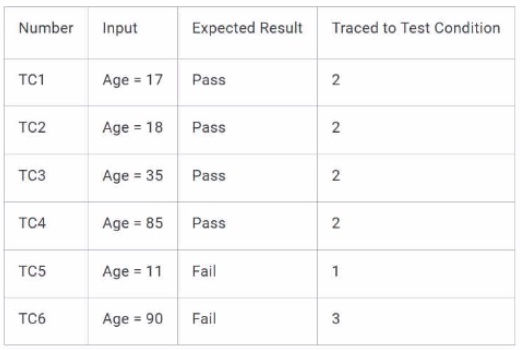
As the Test Manager you are reviewing these Test Cases for traceability to the Test Conditions and to ensure that the change request will be adequately tested in accordance with the Test Strategy.
Which of the following statements is FALSE? SELECT ONE OPTION
Your team has been assigned to lest a new product that is tightly integrated with existing systems The integrations include data transfers and transformations You have access to the architectural design documents and the integration specifications and some of your testers are former developers.
Given this information, what is the most appropriate test approach?
Context Analysis:
The scenario involves tight integration, architectural design, and data transformations, requiring detailed and structured approaches.
Access to architectural documents and experienced testers (former developers) aligns with model-based and white-box techniques.
Evaluation of Options:
A . Model-based and white-box:
Correct. Model-based testing leverages design documents, while white-box testing uses internal knowledge for detailed integration testing.
B . Experience-based and black-box:
Incorrect. This is less structured and doesn't utilize available design documentation or tester expertise.
C . Risk-based and non-functional:
Incorrect. Risk-based testing focuses on high-priority areas but doesn't leverage the design documents for integration specifics.
D . Requirements-based and functional:
Incorrect. While functional testing is relevant, requirements-based testing does not utilize internal system knowledge effectively.
Syllabus Alignment:
ISTQB emphasizes model-based and white-box testing as appropriate for systems with complex integrations (TM-1.2.6).
ISTQB Advanced Level Test Management Syllabus (TM-1.2.6)
An in-house stock management application has been in production for 6 months. 90 defects were found in pre-release testing and 10 were reported from live use. The costs of quality have been determined to be as follows:
* Prevention - <1,000
* Appraisal (average / defect) - 200
* Internal failure (average / defect) - 300
* External failure (average / defect) - 2,000
Which statement is TRUE?
Each defect caught before release (internal failure) costs 300. If it escaped to production, it would cost 2,000. The saving per defect caught early is thus:
2,000 - 300 = 1,700. Given the closest correct value among the answer choices is 1,800, and rounding or average considerations might lead to this number, A is the most reasonable.
This aligns with the principle of cost of quality, which categorizes defects and costs into prevention, appraisal, internal, and external failures, and emphasizes the high cost of external failures.
You have initiated a test process improvement project for your organisation using the STEP model. You have agreed the objectives, goals, scope and coverage of the process improvements with the stakeholders and defined the success criteria that will be applied to the project. Success criteria make risk reduction the most important target benefit for the process improvements, but overall return on investment is also an important consideration. You have just received the initial test
assessment report.
Which ONE of the following would be the next step? SELECT ONE OPTION
Get access to all 228 verified questions with detailed answers.
Unlock All CTAL-TM Questions