4A0-112 Exam Questions & Answers
Nokia IS-IS Routing Protocol • Nokia
100% money-back guarantee
Sample 4A0-112 Questions
Practice with real exam-style questions, each with the verified correct answer and explanation.
A routing domain uses a link-state routing protocol. Which of the following would NOT be an advantage of dividing the entire routing domain into areas?
Dividing a domain into areas typically does not reduce the number of routers needed to handle traffic. It is more focused on improving scalability, reducing the size of routing tables, and limiting the scope of SPF calculations, but it doesn't inherently reduce the number of routers required.
Refer to the exhibit.
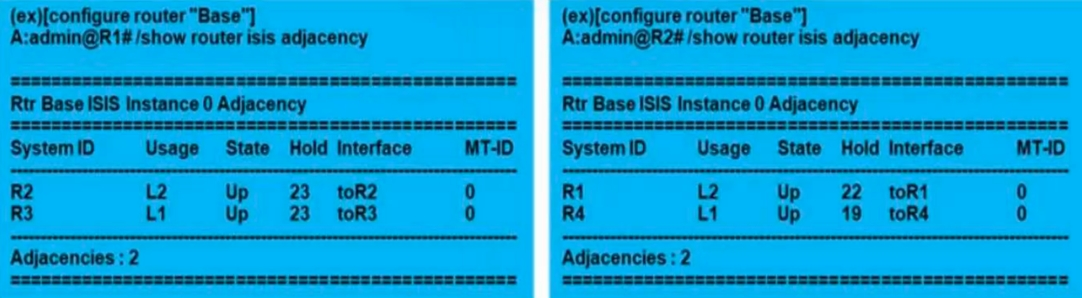
Routers R1, R2, R3, and R4 are running IS-IS. Assuming all interfaces are added to IS-IS as point-to-point and no commands are issued at the interface level to restrict adjacencies, which of the following statements is TRUE?
From the output, we can see that the usage column indicates whether a router is operating as an L1 or L2 router:
The L1/L2 designations refer to whether the routers participate in both Level 1 and Level 2 of IS-IS:
In this case, R1 and R2 are L2 routers, and R3 and R4 are L1 routers.
On a broadcast interface, an IS-IS router receives an LSP that is newer than the one on its database. Which of the following statements best describes the actions taken by the router as a consequence?
When an IS-IS router receives a newer LSP (Link-State PDU) than the one already in its database, it takes the following actions:
Updates its link-state database with the new LSP.
Acknowledges the LSP with a PSNP (Partial Sequence Number PDU), which is sent to the router that originated the LSP, confirming the receipt of the newer LSP.
Floods a copy of the updated LSP to its neighbors on other interfaces to ensure all routers in the network have the updated topology information.
When using IS-IS in native mode for routing in a dual-stack IPv4/IPv6 environment, which of the following statements is FALSE?
In a dual-stack IPv4/IPv6 IS-IS environment, the SPF (Shortest Path First) algorithm is only run once per router for each protocol (IPv4 or IPv6). The topology is shared, but the SPF calculations for IPv4 and IPv6 are separate. This means that the SPF algorithm will run twice (once for IPv4 and once for IPv6) for each L1/L2 router, not four times.
Refer to the exhibit.
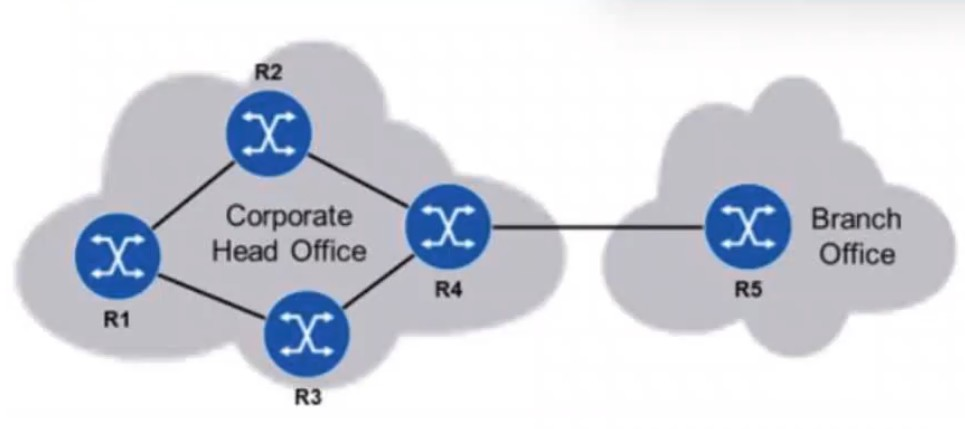
Static routing is to be used in a network between a corporate head office and a branch office. The head office has many connected subnetworks, whereas the branch office has one subnetwork and a single connection to the head office. Which of the following is the most likely configuration on the head office and branch office routers?
The head office has many connected subnetworks, so it will typically have a default route to forward traffic to the branch office (or external networks), since it may not need to define static routes for each branch network.
The branch office, which has only one subnetwork and a single connection to the head office, will have a specific static route to reach the head office subnet or other subnets at the head office, since it only needs to know the specific route to reach the head office's network.
Get access to all 40 verified questions with detailed answers.
Unlock All 4A0-112 Questions