4A0-205 Exam Questions & Answers
Nokia Optical Networking Fundamentals • Nokia
100% money-back guarantee
Sample 4A0-205 Questions
Practice with real exam-style questions, each with the verified correct answer and explanation.
In which of the following forms does the TTI byte provide information on network elements?
Comprehensive and Detailed Explanation From Nokia Optical Networking Fundamentals:
In the Optical Transport Network (OTN) hierarchy, the TTI (Trail Trace Identifier) is a 64-byte overhead signal used to ensure that the source and destination of a path are correctly connected. It is part of the overhead in the OTU (Optical Transport Unit) and ODU (Optical Data Unit) layers. The TTI provides a mechanism for 'path trace' to prevent misconnections. It specifically carries the SAPI (Source Access Point Identifier) and the DAPI (Destination Access Point Identifier).
These identifiers are strings that uniquely identify the source and destination ports. By comparing the 'Expected SAPI/DAPI' configured on a port with the 'Received SAPI/DAPI' actually coming in over the fiber, the Nokia 1830 PSS can detect fiber patching errors or cross-connect mistakes. If there is a mismatch, the system can trigger a TIM (Trace Identifier Mismatch) alarm and potentially squelch the traffic to prevent data from being delivered to the wrong customer. This is a Layer 1 (OTN) function and is entirely independent of Layer 2 MAC addresses or Layer 3 IP addresses used by the management system for DCN (Data Communication Network) connectivity.
What does it take to get connected to the NSP platform?
To get connected to the Nokia Service Platform (NSP) platform, you need a browser and the NSP IP address. Then, you need the credentials to access the web-based interface (WebUI) for the NSP platform. Once you have these, you can access the NSP platform from a web browser.
With reference to the power budget, what is the meaning of receiver dynamic range?
Comprehensive and Detailed Explanation From Nokia Optical Networking Fundamentals:
In the design of a Nokia 1830 PSS optical link, the receiver dynamic range is a critical parameter for ensuring error-free transmission. It defines the 'window' of optical power within which a receiver (such as an SFP, XFP, or coherent line port) can accurately interpret the incoming signal. The lower bound of this range is the Sensitivity, which is the minimum optical power required to achieve a specific Bit Error Ratio (BER). If the power drops below this level, the signal is 'lost in the noise.'
The upper bound is the Overload power (or saturation point), which is the maximum power the receiver can handle before the photo-detector becomes saturated, leading to signal distortion and errors. The dynamic range is the mathematical difference between these two points (expressed in dB). For a network to operate reliably, the calculated power at the end of a fiber span must fall comfortably within this dynamic range. If the signal is too weak, an amplifier is needed; if it is too strong (exceeding the overload point), an optical attenuator must be used to bring the power back into the dynamic range.
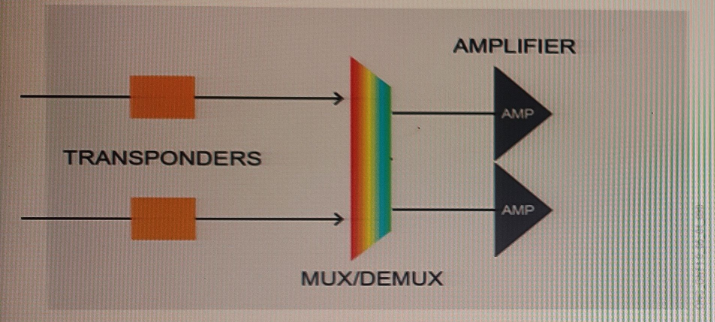
With reference to the image, where is the OPS card placed to provide the OMSP protection?
What is a Shared Risk Group (SRG)?
According to the Nokia Optical Networking documentation, a Shared Risk Group (SRG) is defined as 'a set of network resources that share a common failure risk. When a resource in an SRG fails, the other resources in the group are also affected.' This can include fibers, boards, nodes, and other network resources. The SRG concept is used in network design and protection mechanisms to ensure survivability and minimal impact on service in case of a failure.
Get access to all 59 verified questions with detailed answers.
Unlock All 4A0-205 Questions