4A0-D03 Exam Questions & Answers
Nokia SR Linux EVPN and Data Center Interconnect • Nokia
100% money-back guarantee
Sample 4A0-D03 Questions
Practice with real exam-style questions, each with the verified correct answer and explanation.
Consider the exhibit.
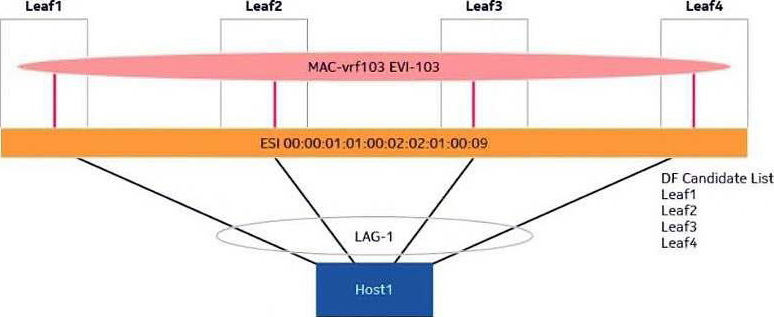
Leaf1 and Leaf2 have the Ethernet segment configured to use the default election algorithm while Leaf3 and Leaf4 are configured to use the preference-based algorithm with Leaf3 having the higher preference value. The DF candidate list is the same on all leaf routers.
Which of the following leafs is the DF for mac-vrf103?
Comprehensive and Detailed 150 to 250 words of Explanation From [SR Linux EVPN and Data Center Interconnect/Course Guide/topics]:
Designated Forwarder election determines which PE forwards BUM traffic from the EVPN overlay toward a multi-homed Ethernet Segment for a given service. In this scenario, all leaf routers share the same DF candidate list for mac-vrf103, but the election configuration is not identical. Leaf1 and Leaf2 use the default algorithm, while Leaf3 and Leaf4 use the preference-based algorithm. Under preference-based DF election, the candidate with the highest configured preference is selected over lower-preference candidates, assuming the candidate list is valid and consistent. The question states that Leaf3 has the higher preference value compared with Leaf4. Therefore, Leaf3 becomes the DF for mac-vrf103. This is the correct outcome because the preference-based election explicitly overrides simple default behavior by assigning operator-defined priority to a PE. In production designs, this is useful when the operator wants deterministic forwarding placement, maintenance control, or service-specific primary-path selection rather than relying only on the default modulo-based DF selection process. Reference: EVPN DF election, preference-based algorithm, MAC-VRF service forwarding.
Consider the exhibit.
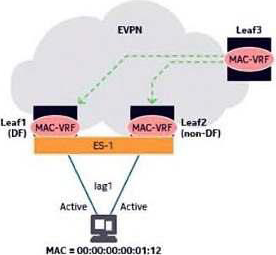
Which of the following statements about the operation of all-active multi-homing is FALSE?
Comprehensive and Detailed 150 to 250 words of Explanation From [SR Linux EVPN and Data Center Interconnect/Course Guide/topics]:
In an all-active Layer 2 EVPN multi-homing design, the host is normally dual-attached through a LAG to multiple leaf routers that share the same Ethernet Segment Identifier. Leaf1 and Leaf2 both participate in the Ethernet Segment and may receive traffic from the host. For BUM traffic sourced by the host, the host-side hashing can send frames toward either attached leaf. For BUM traffic sent from the EVPN overlay toward the multi-homed segment, DF election controls which PE forwards that replicated traffic toward the local Ethernet Segment to prevent duplicate delivery. The false statement is option B. A remote leaf such as Leaf3 does not simply enable ECMP on the MAC-VRF to load-balance traffic between Leaf1 and Leaf2. EVPN all-active forwarding uses Ethernet Segment discovery, Ethernet A-D routes, aliasing, and split-horizon procedures to determine valid next-hops and prevent loops. ECMP alone is an underlay or routing-table behavior; it is not the MAC-VRF mechanism that authorizes multi-homed L2 forwarding across an Ethernet Segment. Reference: all-active L2 EVPN multi-homing, Ethernet Segment association, DF election, aliasing.
Which of the following statements about utilizing asymmetric routing in an L3 EVPN network is FALSE?
Comprehensive and Detailed 150 to 250 words of Explanation From [SR Linux EVPN and Data Center Interconnect/Course Guide/topics]:
Asymmetric routing relies heavily on host MAC/IP information because the ingress PE performs routing into the destination subnet and then sends the frame across the overlay using the destination MAC-VRF/VNI. This means PEs require enough ARP and MAC/IP binding information to forward traffic toward remote hosts correctly. If a host has multiple IP addresses on the same interface, separate EVPN route type 2 advertisements may be needed to communicate each IP-to-MAC binding. The ingress and egress PEs participate in MAC and IP forwarding across the end-to-end service path, but the forwarding responsibilities differ by direction and stage. The false statement is option C. The statement says all MAC-VRFs connected to the L3 EVPN network must exist on each PE, but that is not the correct requirement in this question's verified answer set. In practical EVPN designs, the exact MAC-VRF placement depends on whether the service is implemented as asymmetric, symmetric, interface-less, or interface-ful routing. Here, the course answer marks the universal MAC-VRF requirement as false. Reference: asymmetric L3 EVPN routing, RT-2 MAC/IP advertisements, ARP and MAC forwarding behavior.
Which of the following statements about the configuration of a distributed Layer 2 EVPN in a Nokia SR Linux is FALSE?
Comprehensive and Detailed 150 to 250 words of Explanation From [SR Linux EVPN and Data Center Interconnect/Course Guide/topics]:
A distributed Layer 2 EVPN in SR Linux is implemented using MAC-VRF network instances, EVPN control-plane signaling, and VXLAN data-plane encapsulation. A common mistake is assuming that every PE must use the same EVI value for the same L2 service. In SR Linux, the important operational requirement is that the correct EVPN routes are imported and exported using matching route-target policy, not necessarily that every PE has the same locally configured EVI. Therefore, option A is false. The route distinguisher can be automatically generated using local values such as the autonomous system number and EVI, giving each PE's EVPN routes uniqueness in MP-BGP. A MAC-VRF is associated with VXLAN encapsulation for its data-plane service mapping, and route targets may need to be manually configured when leaf routers are in different autonomous systems because automatic derivation may not produce matching import/export policy across AS boundaries. The key separation is this: the RD gives uniqueness, the route target controls service membership, and the EVI is a local service identifier rather than a universal mandatory match in all designs. Reference: SR Linux distributed L2 EVPN configuration, EVI, RD auto-generation, route-target policy.
Which of the following statements about the decoupled gateway-based data center interconnect solution is FALSE?
Comprehensive and Detailed 150 to 250 words of Explanation From [SR Linux EVPN and Data Center Interconnect/Course Guide/topics]:
In a decoupled gateway-based DCI design, the data center border leaf and the WAN PE are separate devices. Traffic between them can be identified using VLAN tags, allowing different data center EVPN services to be mapped to corresponding WAN VPN services. This architecture provides a clean operational boundary: the border leaf remains aligned with the data center EVPN/VXLAN fabric, while the WAN PE handles WAN VPN transport, QoS, security policy, and service interconnection. The separation gives a strong demarcation point for troubleshooting and administrative control. Option D is false because the WAN PE does not maintain an MP-BGP EVPN peering session with the data center route reflector. In the decoupled model, the route reflector remains part of the data center EVPN control plane, while the WAN PE exchanges routing or service information with the border leaf through the local handoff model. Direct WAN PE-to-data-center-RR peering would blur the separation that defines the decoupled design and would make the WAN PE part of the data center EVPN overlay control plane, which is not the intended architecture. Reference: decoupled gateway DCI, VLAN handoff, WAN VPN mapping, security/QoS demarcation, route-reflector separation.
Get access to all 56 verified questions with detailed answers.
Unlock All 4A0-D03 Questions