4A0-265 Exam Questions & Answers
Nokia Optical Diagnostics and Troubleshooting • Nokia
100% money-back guarantee
Sample 4A0-265 Questions
Practice with real exam-style questions, each with the verified correct answer and explanation.
Which of the following statements about optical power vs amplification stages is TRUE?
The statement that when multiple channels pass through a shared port (for example, an amplifier line interface), the total aggregated power reflects the number of channels currently present is TRUE. This means that the more channels are present, the higher the total output power will be, and vice versa.This is because each channel contributes to the total power by its own power level, and the amplifier tries to maintain a constant gain for each channel2.Therefore, the total output power depends on both the input power and the number of channels3.Reference:Nokia Optical Diagnostics and Troubleshooting Course | Nokia,Optical amplifiers, explained by RP; optical amplification,Amplifier chains, explained by RP; amplifier stages, preamplifier ...
Suppose a "Channel Absent" alarm is reported on an 1830 PSS node. What is the recommended order for the following troubleshooting steps?
The recommended order for the troubleshooting steps is B, as follows:
Retrieve the channel power trace.This step is useful to identify the affected channel and its power level, as well as to check if there are any fluctuations or anomalies in the power trace that could indicate a channel absent issue1.
Retrieve the cross-connection (XC) details and see what Wave Keys should be present.This step is necessary to verify which Wave Keys are expected to be present on the node, card, and port based on the XC configuration2.Wave Keys are unique identifiers for wavelength tracking that are encoded by Optical Transponders (OTs) into each service wavelength direction3.
Go to the suspected troubled node / card / port and look at Wave Keys (in / out). This step is helpful to compare the observed Wave Keys with the expected Wave Keys, and to locate the source of the problem.If a Wave Key is missing or mismatched, it means that there is a channel absent issue on that node, card, or port4.
Check observed Wave Keys against expected Wave Keys. This step is the final solution to resolve the issue and restore the normal operation of the node. The observed Wave Keys should match the expected Wave Keys based on the XC configuration.If not, the XC configuration should be corrected or the faulty node, card, or port should be replaced5.Reference:Nokia Optical Diagnostics and Troubleshooting Course | Nokia,Optical User Guide - Nokia,Alcatel-Lucent 1830 PSS-8 and PSS-16 Photonic Service Switch
Consider the exhibit.
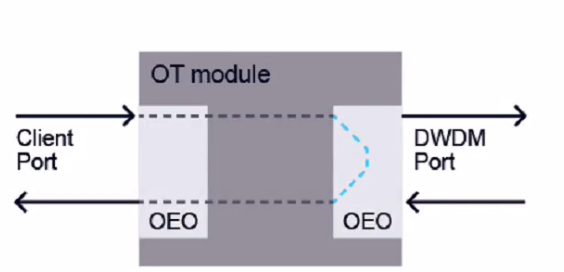
Which type of loopback is applied?
The exhibit shows a diagram of an OT module with a client port and a DWDM port. The client port is looped back to itself with an OEO (Optical-Electrical-Optical) device. This means that the signal received by the client port is converted to an electrical signal, then back to an optical signal, and then transmitted back to the same port. This type of loopback is called a client port terminal loopback.It is used to test the functionality of the client port without involving the DWDM port or any other network element4. A client port facility loopback would involve looping back the signal from the DWDM port to the client port. A line port facility loopback would involve looping back the signal from another OT module or network element to the DWDM port.A line port terminal loopback would involve looping back the signal from the DWDM port to itself5.Reference:Nokia Optical Diagnostics and Troubleshooting Course | Nokia,Loopback - Wikipedia
Which of the following statements about the Wavelength Tracker (WT) capability is TRUE?
The statement that WT uses a unique identifier based on a pair of numbers encoded by Optical Transponders (OTs) into each service wavelength direction is TRUE. WT is a feature of the 1830 PSS that allows for automatic identification and tracking of wavelengths across different network elements and domains. WT uses Wave Keys, which are unique identifiers composed of two numbers: a Wave Key ID and a Wave Key Code.The Wave Key ID identifies the OT that generates the wavelength, while the Wave Key Code identifies the wavelength itself within a given OT6. The Wave Keys are encoded by OTs into each service wavelength direction using phase modulation, and can be decoded by other OTs or amplifiers that have WT capability. WT enables various applications and benefits, such as simplified commissioning, automated wavelength routing, enhanced fault localization, and improved network security.Reference:Nokia Optical Diagnostics and Troubleshooting Course | Nokia,Optical User Guide - Nokia,Alcatel-Lucent 1830 PSS-8 and PSS-16 Photonic Service Switch
A "Power Adjustment Required" alarm was raised on the ingress amplifier in slot 1/10. Which of the following commands should be entered to manually adjust the related amplifier optical power levels?
A ''Power Adjustment Required'' alarm is raised when the optical power levels of an amplifier are out of the expected range and need to be adjusted. To manually adjust the related amplifier optical power levels, the commandconfig powermgmt ingress 1/10 adjustshould be entered. This command will initiate a power adjustment process for the ingress amplifier in slot 1/10, which is the input port for the optical line signal. The command will also display the status and results of the power adjustment, such as success, failure, or conditional success. The other commands are incorrect because they either do not initiate a power adjustment process or have invalid syntax.Reference:Nokia Optical Diagnostics and Troubleshooting Course,OAM and Diagnostics Guide
Get access to all 40 verified questions with detailed answers.
Unlock All 4A0-265 Questions