Limited-Time Offer: Enjoy 50% Savings! - Ends In 0d 00h 00m 00s Coupon code: 50OFF
Free Exam Questions

PMI-PBA Exam Questions & Answers

PMI Professional in Business Analysis  •  PMI

200 Questions Updated Sep 2026 99% Pass Rate
Get Full Access

100% money-back guarantee

Sample PMI-PBA Questions

Practice with real exam-style questions, each with the verified correct answer and explanation.

Q1 MultipleChoice

The document that defines the process for managing requirements revisions is the:

Correct Answer: B
Explanation:

The change management plan outlines the process for managing changes to requirements, ensuring that any revisions are controlled and documented throughout the project lifecycle.Reference: PMI-PBA Examination Content Outline, Business Analysis for Practitioners: A Practice Guide.

Q2 MultipleChoice

A major stakeholder of a project is surprised to learn that a particular requirement was not implemented during the latest launch.

The business analyst tells the stakeholder that the requirement status was changed to "deferred ''

What could have prevented the stakeholder from being surprised about the status change?

Correct Answer: C
Explanation:

Communication is an essential part of requirements management, as it ensures that the requirements are clear, consistent, and agreed upon by all the project stakeholders. Stakeholders are the individuals or groups who have an interest or influence in the project, and who can provide input, feedback, and approval for the requirements. Communication also helps to avoid surprises, misunderstandings, and conflicts among the stakeholders, and to manage their expectations and satisfaction.Communication should be timely, accurate, relevant, and transparent, and should follow the communication plan and strategy defined in the requirements management plan12.

One of the aspects of communication is the status of the requirements, which indicates the progress and completion of the requirements throughout the project life cycle. The status of the requirements can be tracked and documented using a traceability matrix, which is a tool that links the requirements to their sources and traces them throughout the project. The status of the requirements can also be monitored and controlled using a change control process, which is a process that evaluates, approves, and implements any changes to the requirements.The status of the requirements can have different values, such as proposed, approved, implemented, verified, deferred, deleted, or rejected12.

When the status of a requirement changes, it should be communicated to all the project stakeholders, not just the source of the requirement or the project team. This is because the change in the status of a requirement may have an impact on the scope, schedule, cost, quality, or risk of the project, and may affect the interests or expectations of the stakeholders. Communicating the status of the requirements to all the project stakeholders helps to keep them informed and engaged, and to obtain their feedback and approval.It also helps to prevent surprises, such as the one experienced by the major stakeholder in the question, who was unaware that a particular requirement was deferred12.

Therefore, the best option is C. The status should have been communicated to all project stakeholders. Option A is not the best option, because the status should have been communicated to more than just the requirement's source. Option B is not the best option, because the status should have been communicated earlier than prior to project launch.Option D is not the best option, because updating the status in the traceability matrix is not enough, as the stakeholders may not have access to or awareness of the matrix.References:1PMI Professional in Business Analysis (PMI-PBA) Examination Content Outline, page 9-11;2Requirements Management 101 | Smartsheet2

Q3 MultipleChoice

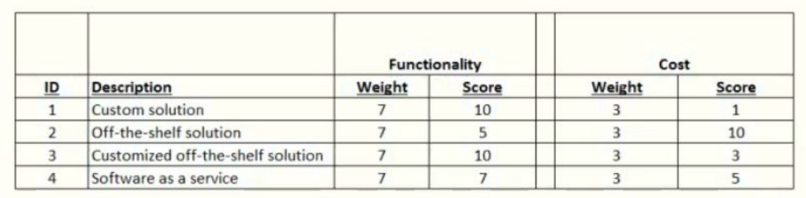
Refer to the exhibit.

A company uses a prioritization range of 1-10, in which 10 represents the highest or best. According to the information from the table, which option should the business analyst recommend?

Correct Answer: C
Explanation:

According to the PMI Professional in Business Analysis objectives and content, the business analyst should recommend the option with the highest functionality score and the lowest cost score. In this case, option A, 1, Custom solution, has the highest functionality score of 10 and the lowest cost score of 1. Therefore, it should be recommended.Reference:

PMI Professional in Business Analysis objectives and content: PMI-PBA Certification

PMI Professional in Business Analysis reference list: PBA Reference List

PMI Professional in Business Analysis study guide: PMI.com

Q5 MultipleChoice

A startup company sells organic vegetable and fruit smoothies. Management is tracking a rapid decrease in sales of their best-selling juice, so they contract a business analyst to identify solutions in order to increase sales by comparing similar products offered by competitors.

Which technique or tool should be used?

Correct Answer: A
Explanation:

Competitive analysis is a technique to compare the strengths and weaknesses of similar products or services offered by competitors in the same market. Competitive analysis can help to identify opportunities, threats, and gaps in the market, and to develop strategies to increase sales and customer satisfaction. Competitive analysis can be used to identify solutions for the startup company that sells organic vegetable and fruit smoothies by comparing their best-selling juice with similar products offered by competitors. The other techniques are not suitable for this purpose. Benchmarking is a technique to compare the performance of a product, service, or process with a standard or best practice. Trend analysis is a technique to analyze historical data or patterns to forecast future outcomes or behaviors. Focus group is a technique to elicit opinions, preferences, or feedback from a representative group of customers or users.Reference: PMI-PBA Examination Content Outline, page 11; PMI-PBA Reference List, page 1, BABOK Guide v3, page 51.

Get access to all 200 verified questions with detailed answers.

Unlock All PMI-PBA Questions

Frequently Asked Questions

To be eligible for the PMI-PBA exam, you must have a secondary degree (high school diploma or equivalent) and a minimum of 4,500 hours of business analysis experience within the past 10 years. Additionally, you must complete 35 contact hours of formal business analysis education or training.

The PMI-PBA exam is 3.5 hours long and consists of 200 multiple-choice questions. The questions are designed to test your knowledge across various business analysis domains and competencies.

The exam covers five main domains: business analysis planning and monitoring, elicitation and collaboration, requirements life cycle management, requirements analysis, and stakeholder engagement and communication. Each domain contains multiple knowledge areas and competencies that are tested.

The PMI-PBA exam costs $555 for PMI members and $700 for non-members as of recent pricing. PMI membership typically costs $139 annually, so membership can be cost-effective if you plan to take multiple PMI exams.

No, the PMI-PBA and CCBA (Certified Business Analyst) are different certifications from different organizations. The PMI-PBA is offered by the Project Management Institute, while the CCBA is offered by the International Institute of Business Analysis (IIBA), and they have different prerequisites, content, and requirements.
Exam Details
  • Exam CodePMI-PBA
  • VendorPMI
  • Total Questions200
  • LanguageEnglish
  • Last UpdatedSep 3, 2026
4.9/5

Pass PMI-PBA First Time

Get all 200 exam questions with verified answers and 90-day free updates.

Buy Now & Pass
  • PDF + Practice Test Bundle
  • 90-Day Free Updates
  • 100% Money-Back Guarantee
  • Instant Download
  • 24/7 Customer Support
99% Pass Rate Trusted by 50,000+ IT professionals