Marketing-Cloud-Intelligence Exam Questions & Answers
Marketing Cloud Intelligence Accredited Professional • Salesforce
100% money-back guarantee
Sample Marketing-Cloud-Intelligence Questions
Practice with real exam-style questions, each with the verified correct answer and explanation.
A client has integrated data from Facebook Ads. Twitter ads, and Google ads in marketing Cloud intelligence. For each data source, the source, the data follows a naming convensions as ...
Facebook Ads Naming Convention - Campaign Name:
CampID_CampName#Market_Object#object#targetAge_TargetGender
Twitter Ads Naming Convention- Media Buy Name
MarketTargeAgeObjectiveOrderID
Google ads Naming Convention-Media Buy Name:
Buying_type_Market_Objective
The client wants to harmonize their data on the common fields between these two platforms (i.e. Market and Objective) using the Harmonization Center. Given the above information, which statement is correct regarding the ability to implement this request?
wet Me - Given the above information, which statement i 's Correct regarding the ability to implement this request?
Despite the different naming conventions, harmonization is possible using patterns in the Harmonization Center. By extracting the 'Market' and 'Objective' components from the naming conventions of each platform, three separate patterns would be created to map these common fields consistently across the data from Facebook Ads, Twitter Ads, and Google Ads.
A client's data consists of three data sources - Facebook Ads, LinkedIn Ads and Google Campaign Manager.
Notes:
* The client is planning on adding an additional 100 Facebook Ads data streams and 50 more LinkedIn Ads data streams.
* The final volume of data in the workspace will be 5M rows
* Each data source has a naming convention and it can be assumed that any additional profile (i.e. Data Stream) from one of these sources will follow the same naming convention.
The client provided the following sample files:
Facebook Ads:
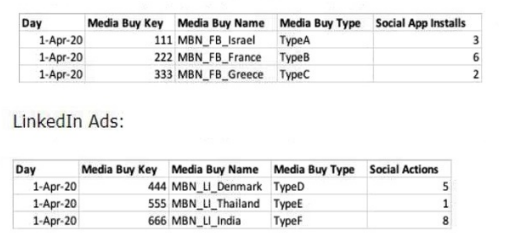
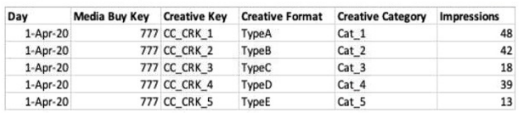
The client would like to create a new harmonization field named "Market," which will only be coming from Facebook Ads and LinkedIn Ads. The logic for
"Market" is the following:
IF Media Buy Type is equal to "TypeB" or "TypeC" or "TypeD"
Return 'Europe'
ELSE
Return 'Rest Of The World'
In order to create the harmonization field Market, the client considers using either Mapping Formula, Calculated Dimension, VLOOKUP or Patterns.
Considering maintenance and scalability, which option is recommended?
Patterns are the best approach in this scenario because:
Scalability: Patterns are highly scalable and can easily handle the addition of 100 more Facebook Ads and 50 more LinkedIn Ads streams. You can define pattern-matching rules that automatically apply to new data streams based on the naming conventions.
Flexibility and Maintenance: Patterns allow you to maintain and adjust logic easily. Since the logic for determining 'Market' is based on a defined naming convention (e.g., Media Buy Type), Patterns can handle these rules effectively without requiring manual updates or static tables.
Efficient Harmonization: Patterns automatically classify data based on defined rules, reducing the need for ongoing manual maintenance compared to approaches like VLOOKUP or Mapping Formulas, which might require frequent updates as data changes.
Why not other options?
Mapping Formulas: While Mapping Formulas work well for static mappings, they are not as scalable or maintainable when the dataset grows or changes frequently.
Calculated Dimension: This option is valid for simple logic but is less maintainable for large-scale datasets, especially when new data streams are added.
VLOOKUP: This method is manual and not scalable. It would require you to update lookup tables for each new data stream, which is inefficient given the expected growth of the data.
Your client would like to create a new harmonization field - Exam Topic.
The below table represents the harmonization logic from each source.
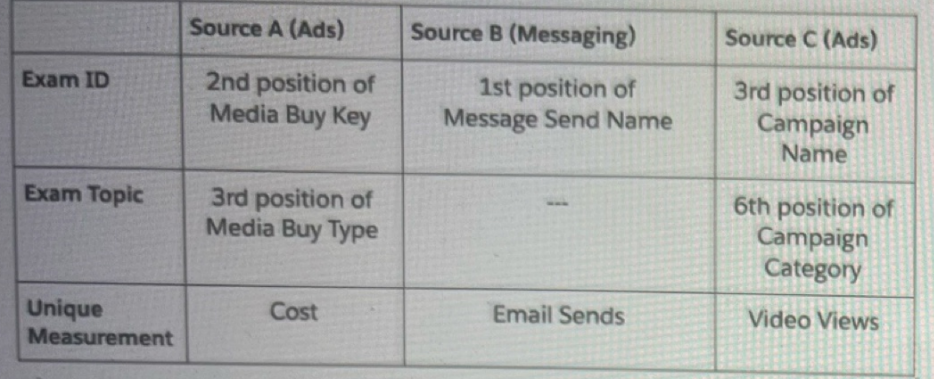
As can be seen from the table there are in fact two fields that hold a certain connection: Exam ID and Exam Topic. The connection indicates that where an Exam ID is found -a single Exam Topic value is associated with it.
The Client has a requirement to be able to view measurements from all data sources sliced by Exam Topic values as seen in the following example:

Which harmonization feature should an Implementation engineer use to meet the client's requirement?
To meet the client's requirement of slicing measurements by 'Exam Topic' values, an Implementation Engineer should use Custom Classification. This feature allows different Exam IDs to be classified into their respective Exam Topics, ensuring that data from all sources can be accurately harmonized and analyzed based on these topics.
A client's data consists of three data streams as follows:
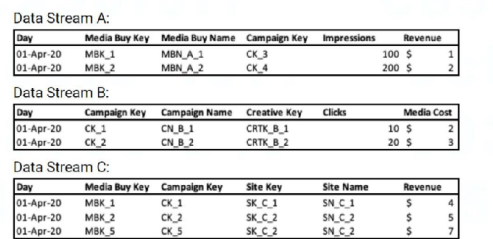
* The data streams should be linked together through a parent-child relationship.
* Out of the three data streams, Data Stream C is considered the source of truth for both the dimensions and measurements.
Which data stream should be set as a parent?
Since Data Stream C is considered the source of truth for both dimensions and measurements, it should be set as the parent data stream. This is because the parent data stream is used as the primary source for hierarchical and attribute data within a parent-child relationship setup. As the source of truth, Data Stream C will provide the foundational data upon which the other streams can be aligned and will ensure consistency and accuracy across the linked data.
A client has integrated data from Facebook Ads, Twitter Ads, and Google Ads in Marketing Cloud Intelligence. For each data source, the data
follows a naming convention as shown below:
Facebook Ads Naming Convention - Campaign Name:
Camp|D_CampName#Market_Objective#TargetAge_TargetGender
Twitter Ads Naming Convention - Media Buy Name:
Market|TargetAge|Objective|OrderID
' Google Ads Naming Convention - Media Buy Name:
Buying Type_Market_Objective
The client wants to harmonize their data on the common fields between these two platforms (i.e. Market and Objective) using the Harmonization 'Center.
In addition to the previous details, the client provides the following data sample:
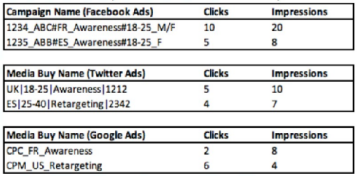
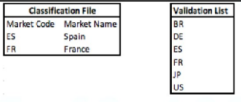
Logic specification:
If a value is not present in the Validation List, return ''Not Valid''
If a value is not present in the Classification File, return ''Unclassified''.
If the Harmonization center is used to harmonize the above data and files, what table will show the final output?
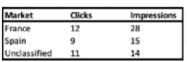
A)
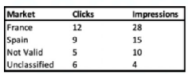
B)
C)
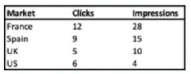
D)
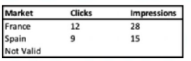
The correct table would be Option B. The harmonization process would identify the 'Market' from the campaign or media buy name based on the delimiter and position rules specified in the naming conventions. The harmonized 'Market' would then be matched against the classification file and validation list. If a value does not match the validation list, it would return 'Not Valid', and if it's not present in the classification file, it would return 'Unclassified'. Option B is the only table showing the 'Not Valid' category which aligns with the logic specification provided.
Get access to all 63 verified questions with detailed answers.
Unlock All Marketing-Cloud-Intelligence Questions