Salesforce-MuleSoft-Developer-II Exam Questions & Answers
Salesforce Certified MuleSoft Developer II • Salesforce
100% money-back guarantee
Sample Salesforce-MuleSoft-Developer-II Questions
Practice with real exam-style questions, each with the verified correct answer and explanation.
When registering a client application with an existing API instance or API Group instance, what is required to manually approve or reject request access?
To manually approve or reject request access when registering a client application with an existing API instance or API Group instance, it is required to configure the SLA tier for the application and have one of the following roles or permissions: Organization Administrator, API Manager Environment Administrator, or Manage Contracts permission. These roles or permissions allow managing client applications and contracts in API Manager. Reference: https://docs.mulesoft.com/api-manager/2.x/client-applications#managing-client-applications-and-contracts
A custom policy needs to be developed to intercept all cutbound HTTP requests made by Mule applications.
Which XML element must be used to intercept outbound HTTP requests?
The http-policy:processor element is used to intercept outbound HTTP requests made by Mule applications. It allows customizing the request before it is sent to the target API and modifying the response after it is received from the target API. Reference: https://docs.mulesoft.com/api-manager/2.x/policy-mule4-custom-policy#policy-xml-file
Refer to the exhibit.
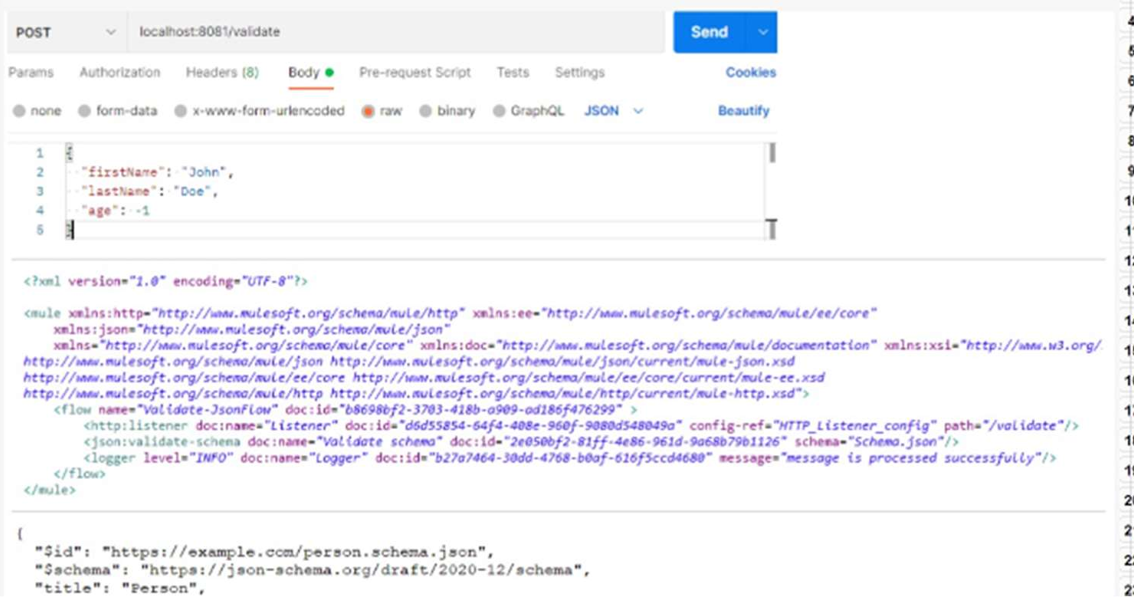
Based on the code snippet, schema,json file, and payload below, what is the outcome of the given code snippet when a request is sent with the payload?
Based on the code snippet, schema.json file, and payload below, the outcome of the given code snippet when a request is sent with the payload is that the Mule flow will throw the exception 'JSON:SCHEMA_NOT_HONOURED'. This is because the payload does not conform to the schema.json file, which specifies that age must be a number greater than or equal to zero. The payload has age as a string with a negative value, which violates the schema. Therefore, the validate-schema operation throws an error with type 'JSON:SCHEMA_NOT_HONOURED'. Reference: https://docs.mulesoft.com/json-module/1.1/json-validate-schema
In a Mule project, Flow-1 contains a flow-ref to Flow-2 depends on data from Flow-1 to execute successfully.
Which action ensures the test suites and test cases written for Flow-1 and Flow-2 will execute successfully?
To ensure the test suites and test cases written for Flow-1 and Flow-2 will execute successfully, the developer should use a Set Event processor to pass the input that is needed by Flow-2, and keep the test cases for Flow-1 and Flow-2 independent. This way, the developer can isolate the testing of each flow and avoid coupling them together. Reference: https://docs.mulesoft.com/munit/2.3/munit-test-flow
A Mule application includes a subflow containing a Scatter.Gather scope. Within each log of the Scatter.Gatter. an HTTP connector calls a PUT endpoint to modify records in different upstream system. The subflow is called inside an Unit successful scope to retry if a transitory exception is raised.
A technical spike is being performed to increase reliability of the Mule application.
Which steps should be performed within the Mule flow above the ensure idempontent behavior?
To ensure idempotent behavior within a Mule flow that contains a subflow with a Scatter-Gather scope, the developer should ensure an error-handling flow performs corrective actions to roll back all changes if any leg of the Scatter-Gather fails. Idempotency means that multiple identical requests have the same effect as a single request. Therefore, if one of the HTTP requests inside the Scatter-Gather fails, the error-handling flow should undo any changes made by other successful requests to ensure consistency and avoid partial updates. Reference: https://docs.mulesoft.com/mule-runtime/4.3/scatter-gather-concept https://docs.mulesoft.com/mule-runtime/4.3/error-handling
Get access to all 60 verified questions with detailed answers.
Unlock All Salesforce-MuleSoft-Developer-II Questions