Financial-Management Exam Questions & Answers
WGU Financial Management • WGU
100% money-back guarantee
Sample Financial-Management Questions
Practice with real exam-style questions, each with the verified correct answer and explanation.
How does the global bond market impact the strategies of multinational corporations?
Multinational corporations (MNCs) often seek the lowest-cost and most flexible sources of long-term financing. The global bond market expands their choices beyond domestic lenders and investors, enabling firms to issue debt in multiple countries, currencies, and structures (fixed vs. floating rates, maturities, secured vs. unsecured, and different covenant packages). This broad access can reduce the weighted average cost of capital (WACC) if foreign markets provide lower yields, deeper investor demand, or better terms for the issuer's credit profile. Global issuance can also support operational needs: an MNC earning revenues in euros or yen may issue bonds in those currencies to create a natural hedge, matching debt service with foreign-currency cash inflows and reducing exchange-rate exposure. However, the global bond market does not remove currency risk automatically (so B is incorrect), nor does it guarantee fixed interest rates (D is incorrect). While domestic issuance remains important, global markets increase strategic flexibility, allowing firms to optimize capital structure, diversify funding sources, manage refinancing risk, and tailor financing to geographic cash flows---core themes in international financial management.
Use Whole Pine Inc.'s financial statements for 20X3 below to answer the following question.
What is Whole Pine Inc.'s total asset turnover for 20X3?
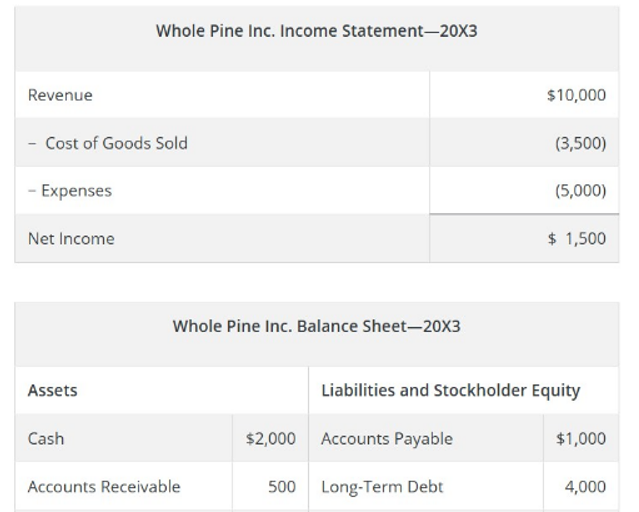
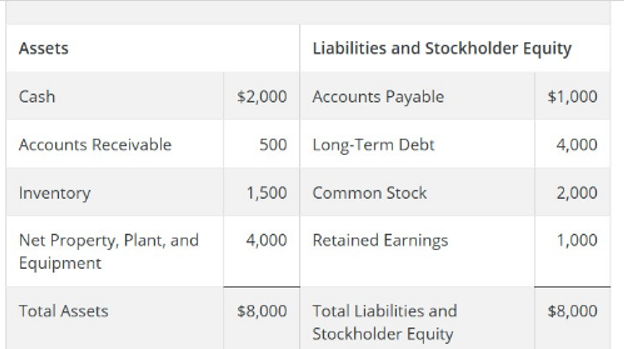
Total asset turnover measures how efficiently a firm uses its assets to generate revenue. It is calculated as Sales Total Assets. For Whole Pine Inc., sales for 20X3 are $10,000 and total assets are $8,000. Dividing $10,000 by $8,000 yields a total asset turnover of 1.25. This means the company generates $1.25 in sales for every $1.00 invested in assets. From a financial management perspective, this ratio is a key indicator of operating efficiency and is commonly compared across firms within the same industry or across time. A higher turnover suggests more efficient use of assets, while a lower turnover may indicate underutilized capacity or inefficient asset deployment. Asset turnover is also a component of the DuPont analysis, linking operational efficiency to return on equity. Option B correctly reflects both the calculation and interpretation consistent with standard financial analysis practice.
What does the DuPont equation decompose return on equity (ROE) into?
The DuPont equation breaks return on equity (ROE) into three key components to show how profitability, efficiency, and leverage interact to drive shareholder returns. The classic three-step DuPont formula expresses ROE as:
ROE = Net Profit Margin Total Asset Turnover Equity Multiplier (or leverage measure).
Net profit margin reflects operating and cost efficiency, total asset turnover measures how effectively assets generate sales, and the equity multiplier (closely related to the debt-to-equity ratio) captures the impact of financial leverage. This decomposition allows analysts and managers to identify whether changes in ROE are driven by margins, asset utilization, or financing decisions. Option D correctly aligns with this framework by identifying net margin and asset turnover along with a leverage measure (debt-to-equity). The other options include ratios not used in the DuPont framework or omit a critical component. The DuPont analysis is widely used in financial management to diagnose performance issues and guide strategic improvements.
What distinguishes free cash flow to equity (FCFE) from free cash flow to the firm (FCFF)?
Free cash flow concepts are central to valuation. Free cash flow to the firm (FCFF) represents cash available to all capital providers---both debt and equity---before interest and principal repayments. In contrast, free cash flow to equity (FCFE) measures the cash available exclusively to common shareholders after all operating expenses, capital expenditures, working capital needs, and debt obligations (interest and principal) have been satisfied. This distinction determines which discount rate analysts use: FCFF is discounted at the weighted average cost of capital (WACC), while FCFE is discounted at the cost of equity. FCFE is especially useful when valuing equity directly or when a firm's leverage is stable and predictable. Option C correctly captures this defining difference, while the other options misstate cash flow allocation or confuse accounting adjustments with distributable cash.
Which requirement does the Sarbanes--Oxley Act (SOX) impose on company executives?
Under the Sarbanes--Oxley Act, senior executives---specifically the CEO and CFO---are required to certify that the company's financial statements fairly present the firm's financial condition and results of operations. This requirement increases executive accountability and ensures that financial reporting integrity is taken seriously at the highest level of management. False certification can result in severe civil and criminal penalties. Financial management texts emphasize that this provision aligns executive incentives with shareholder interests by making leaders directly responsible for financial transparency and accuracy. Option C correctly states this executive requirement.
Get access to all 83 verified questions with detailed answers.
Unlock All Financial-Management Questions