4A0-114 Exam Questions & Answers
Nokia Border Gateway Protocol Fundamentals for Services • Nokia
100% money-back guarantee
About 4A0-114 Exam
The 4A0-114 Nokia Border Gateway Protocol Fundamentals for Services certification exam is a comprehensive assessment designed to validate your expertise in BGP routing protocols and their implementation within Nokia service provider environments. This certification covers essential topics including BGP protocol fundamentals, route filtering, policy configuration, path selection mechanisms, and advanced BGP features necessary for managing modern service provider networks. Professionals pursuing this certification gain in-depth knowledge of how BGP operates in real-world telecommunications infrastructure, making them valuable assets to organizations managing complex routing environments and service delivery platforms.
This exam is ideal for network engineers, system administrators, and telecommunications professionals who work with Nokia equipment and require a solid foundation in Border Gateway Protocol implementations. Candidates preparing for the 4A0-114 exam benefit significantly from utilizing updated exam dumps and practice tests, which provide realistic exam simulations and help identify knowledge gaps before the actual assessment. These study resources offer practice questions that mirror the official exam format, enabling candidates to build confidence, improve time management skills, and achieve higher pass rates. By combining comprehensive study materials with hands-on practice tests, aspiring professionals can effectively prepare for the certification and demonstrate their BGP expertise to employers and industry peers.
Exam Topics & Objectives
4-Week Study Plan for 4A0-114
Week 1: BGP Fundamentals & Protocol Basics
- Study BGP overview, history, and role in modern networks
- Learn BGP terminology: AS numbers, AS path, origin, MED, local preference
- Understand BGP message types: Open, Update, Keepalive, Notification
- Review BGP finite state machine: Idle, Connect, Active, OpenSent, OpenConfirm, Established
- Practice configuring basic BGP sessions on Nokia routers
- Study BGP attributes and their classification: Well-known, optional, transitive, non-transitive
- Complete practice questions on BGP fundamentals
Week 2: Multi-Protocol BGP & Address Families
- Study multi-protocol BGP (MP-BGP) concepts and design
- Learn IPv4 and IPv6 address family configuration
- Understand MPLS and VPN address families (VPNv4, VPNv6)
- Study capability negotiation and address family advertisement
- Configure MP-BGP for IPv6 on Nokia routers
- Practice configuring VPNv4 and VPNv6 address families
- Review BGP next-hop handling across different address families
- Complete hands-on labs for multi-protocol BGP scenarios
Week 3: BGP Route Reflectors & Cluster Architecture
- Study route reflector concepts and cluster design principles
- Learn route reflector clients, non-clients, and IBGP mesh alternatives
- Understand cluster ID and originator ID attributes
- Study reflector scalability and redundancy configurations
- Configure primary and backup route reflectors on Nokia routers
- Practice cluster design for large AS networks
- Review route reflection with multiple clusters
- Study BGP route reflection best practices and limitations
Week 4: Integration, Advanced Topics & Exam Preparation
- Integrate BGP fundamentals, MP-BGP, and route reflectors in complex scenarios
- Study BGP convergence, failover, and recovery mechanisms
- Review BGP policy configuration and route filtering techniques
- Practice BGP troubleshooting methodologies on Nokia systems
- Complete full-length practice exams covering all three modules
- Review weak areas and reinforce knowledge gaps
- Study real-world case studies combining all BGP concepts
- Perform final review of exam objectives and take final practice tests
Sample 4A0-114 Questions
Practice with real exam-style questions. Reveal answers to verify your knowledge.
A router in AS 65100 receives three routes for 138.120.0.0/16. The first route has an AS Path of 65200 65400 65300 and a local preference of 150. The second route has an AS Path of 65200 65300 and a local preference of 100. The third route has an AS Path of 65600 65300 and a local preference of 100. Which route will appear in the RIB-out?
Click the exhibit.
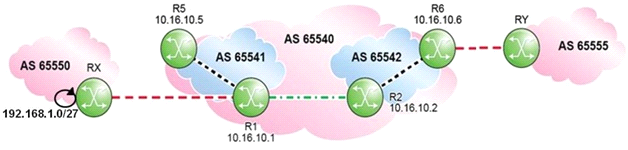
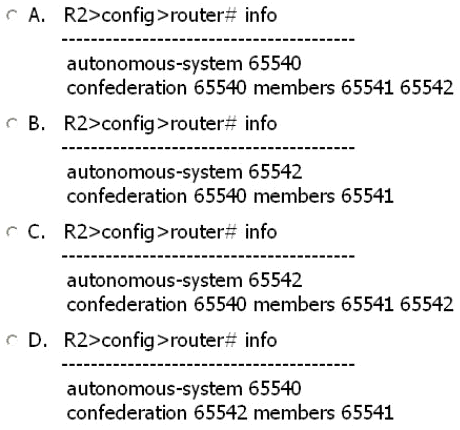
Which of the following is a valid confederation configuration for Router R2?
What does an EVPN VPLS do that a traditional VPLS does not do?
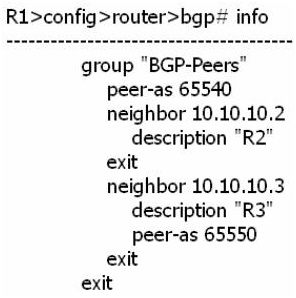
The configuration of an Nokia 7750 SR is given below. Router Rl has established BGP sessions with routers R2 and R3. Which of the following is TRUE?
Which of the following attributes can be used to prevent route advertisement loops in a network using router reflectors?
Get access to all 44 verified questions with detailed answers.
Unlock All 4A0-114 Questions