HPE6-A78 Exam Questions & Answers
Aruba Certified Network Security Associate Exam • HP
100% money-back guarantee
Sample HPE6-A78 Questions
Practice with real exam-style questions, each with the verified correct answer and explanation.
A company with 382 employees wants to deploy an open WLAN for guests. The company wants the experience to be as follows:

The company also wants to provide encryption for the network for devices mat are capable, you implement Tor the WLAN?
Which security options should
For a company that wants to deploy an open WLAN for guests with the ease of access and encryption for capable devices, using a captive portal with Opportunistic Wireless Encryption (OWE) in transition mode would be suitable. The captive portal allows for a user-friendly login page for authentication without a pre-shared key, and OWE provides encryption to protect user data without the complexities of traditional WPA or WPA2 encryption, which is ideal for guest networks. Transition mode allows devices that support OWE to use it while still allowing older or unsupported devices to connect. :
Wi-Fi Alliance recommendations for OWE.
Best practices for guest Wi-Fi network setup.
What is a correct guideline for the management protocols that you should use on ArubaOS-Switches?
In managing ArubaOS-Switches, the best practice is to disable less secure protocols such as Telnet and use more secure alternatives like SSH (Secure Shell). SSH provides encrypted connections between network devices, which is critical for maintaining the security and integrity of network communications. This guideline is aligned with general security best practices that prioritize the use of protocols with strong, built-in encryption mechanisms to prevent unauthorized access and ensure data privacy.
What is social engineering?
Social engineering in the context of network security refers to the techniques used by hackers to manipulate individuals into breaking normal security procedures and best practices to gain unauthorized access to systems, networks, or physical locations, or for financial gain. Hackers use various forms of deception to trick employees into handing over confidential or personal information that can be used for fraudulent purposes. This definition encompasses phishing attacks, pretexting, baiting, and other manipulative techniques designed to exploit human psychology. Unlike other hacking methods that rely on technical means, social engineering targets the human element of security. to social engineering, its methods, and defense strategies are commonly found in security training manuals, cybersecurity awareness programs, and authoritative resources like those from the SANS Institute or cybersecurity agencies.
Refer to the exhibit.
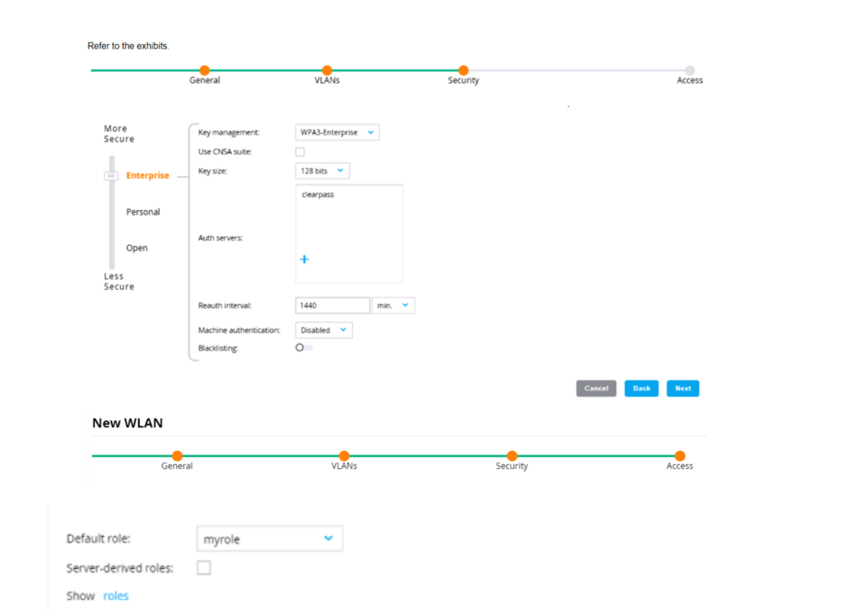
An admin has created a WLAN that uses the settings shown in the exhibits (and has not otherwise adjusted the settings in the AAA profile) A client connects to the WLAN Under which circumstances will a client receive the default role assignment?
In the context of an Aruba Mobility Controller (MC) configuration, a client will receive the default role assignment if they have passed 802.1X authentication and the authentication server did not send an Aruba-User-Role Vendor Specific Attribute (VSA). The default role is assigned by the MC when a client successfully authenticates but the authentication server provides no specific role instruction. This behavior ensures that a client is not left without any role assignment, which could potentially lead to a lack of network access or access control. This default role assignment mechanism is part of Aruba's role-based access control, as documented in the ArubaOS user guide and best practices.
You have enabled 802.1X authentication on an AOS-CX switch, including on port 1/1/1. That port has these port-access roles configured on it:
Fallback role = roleA
Auth role = roleB
Critical role = roleC
No other port-access roles are configured on the port. A client connects to that port. The user succeeds authentication, and CPPM does not send an Aruba-User-Role VSA.
What role does the client receive?
In an AOS-CX switch environment, 802.1X authentication is used to authenticate clients connecting to ports, and roles are assigned based on the authentication outcome and configuration. The roles mentioned in the question---fallback, auth, and critical---have specific purposes in the AOS-CX port-access configuration:
Auth role (roleB): This role is applied when a client successfully authenticates via 802.1X and no specific role is assigned by the RADIUS server (e.g., via an Aruba-User-Role VSA). It is the default role for successful authentication.
Fallback role (roleA): This role is applied when no authentication method is attempted (e.g., the client does not support 802.1X or MAC authentication and no other method is configured).
Critical role (roleC): This role is applied when the switch cannot contact the RADIUS server (e.g., during a server timeout or failure), allowing the client to have limited access in a 'critical' state.
In this scenario, the client successfully authenticates via 802.1X, and CPPM does not send an Aruba-User-Role VSA. Since authentication is successful, the switch applies the auth role (roleB) as the default role for successful authentication when no specific role is provided by the RADIUS server.
Option A, 'The client receives roleC,' is incorrect because the critical role is only applied when the RADIUS server is unreachable, which is not the case here since authentication succeeded.
Option B, 'The client is denied access,' is incorrect because the client successfully authenticated, so access is granted with the appropriate role.
Option D, 'The client receives roleA,' is incorrect because the fallback role is applied only when no authentication is attempted, not when authentication succeeds.
The HPE Aruba Networking AOS-CX 10.12 Security Guide states:
'When a client successfully authenticates using 802.1X, the switch assigns the client to the auth role configured for the port, unless the RADIUS server specifies a different role via the Aruba-User-Role VSA. If no Aruba-User-Role VSA is present in the Access-Accept message, the auth role is applied.' (Page 132, 802.1X Authentication Section)
Additionally, the guide clarifies the roles:
'Auth role: Applied after successful 802.1X or MAC authentication if no role is specified by the RADIUS server.'
'Fallback role: Applied when no authentication method is attempted.'
'Critical role: Applied when the RADIUS server is unavailable.' (Page 134, Port-Access Roles Section)
:
HPE Aruba Networking AOS-CX 10.12 Security Guide, 802.1X Authentication Section, Page 132.
HPE Aruba Networking AOS-CX 10.12 Security Guide, Port-Access Roles Section, Page 134.
Get access to all 168 verified questions with detailed answers.
Unlock All HPE6-A78 Questions