HPE7-J01 Exam Questions & Answers
Advanced HPE Storage Architect Written Exam • HP
100% money-back guarantee
Sample HPE7-J01 Questions
Practice with real exam-style questions, each with the verified correct answer and explanation.
An HPE Partner is creating a proposal for an HPE customer that involves HPE Morpheus Enterprise. What does the partner need to determine to configure the correct number of Morpheus licenses in Online Config Advanced (OCA)?
HPE Morpheus Enterprise is a comprehensive multi-cloud management and orchestration platform that enables self-service provisioning and lifecycle management across private and public clouds. To accurately size and quote a Morpheus solution in tools like HPE Online Config Advanced (OCA), the primary licensing metric is the Workload Element (WLE), also frequently referred to as a Workload Element (WE) in some documentation.
A Workload Element is defined as a granular unit of compute directly associated with an application service that is being managed or inventoried by Morpheus. This includes:
Virtual Machines (VMs) on-premises (e.g., VMware vCenter, Hyper-V).
Instances in the public cloud (e.g., AWS EC2, Azure VMs, Google Cloud instances).
Bare metal servers if they are provisioned to run application services.
Container deployments (such as Kubernetes pods).
Importantly, Morpheus does not count supporting infrastructure like storage arrays, load balancers, or physical hypervisor hosts (e.g., the physical server running ESXi) as Workload Elements. Licensing is typically based on a concurrent model, meaning the customer must license the total number of WLEs under management at any given time, regardless of whether they are located on-prem or in a public cloud. Therefore, the partner must calculate the aggregate sum of all VMs and cloud instances the customer intends to manage to ensure the license quantity in OCA is correct.
Refer to the exhibit.
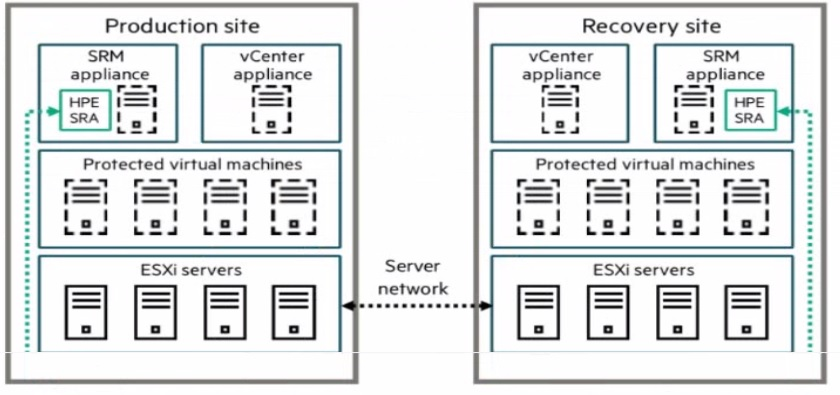
A company is implementing a disaster recovery solution. The Asynchronous Remote Copy feature has been implemented between the HPE AUetra 9000 arrays at both sites. The customer Is interested in providing a disaster recovery (DR) solution that allows for business connectivity of their VMware VMs.
Which VMware solution should the company implement?
To provide automated orchestration and business continuity for VMware virtual machines in a disaster recovery scenario, the industry-standard solution integrated with HPE storage is VMware Live Site Recovery (formerly known as VMware Site Recovery Manager or SRM).
When a customer utilizes Asynchronous Remote Copy on HPE Alletra 9000 arrays, the storage layer handles the data replication between the production and recovery sites. However, the storage array alone cannot automate the re-registration of virtual machines, the mapping of network port groups, or the specific power-on sequencing required for complex applications at the secondary site. VMware Live Site Recovery serves as the orchestration engine that bridges this gap. It works in conjunction with a Storage Replication Adapter (SRA) provided by HPE. The HPE SRA allows the VMware software to communicate directly with the Alletra 9000 arrays to initiate tasks such as promoting recovery volumes to a read-write state, taking temporary snapshots for DR testing, and automating the 'failover' and 'failback' workflows.
As shown in the exhibit (image_6601ef.jpg), a complete solution requires an SRM appliance and a vCenter appliance at both the production and recovery sites. This architecture ensures that even if the primary site is completely lost, the recovery site has all the necessary metadata and orchestration instructions to bring the business-critical VMs online with minimal manual intervention. Option A (Lifecycle Management) is for patching and updates, Option D (Storage DRS) is for load balancing within a cluster, and Option C refers to operational monitoring rather than disaster recovery orchestration. For a customer already invested in Alletra 9000 Remote Copy, VMware Live Site Recovery is the 'Better Together' choice for achieving low Recovery Time Objectives (RTO).
Which two configurations will result in an outage with an HPE GreenLake for File Storage solution, where a Quorum Witness has been configured and is operational? (Choose two.)
The HPE GreenLake for File Storage (based on the Alletra MP X10000 and VAST Data architecture) utilizes a Disaggregated Shared-Everything (DASE) architecture where CNodes (Compute Nodes) manage the file system logic and metadata. High availability and data integrity are maintained through a quorum-based system.
In a standard cluster environment, a strict majority of nodes ($n/2 + 1$) must be operational to maintain the 'Quorum,' which is the state required to acknowledge I/O and prevent 'split-brain' scenarios. While a Quorum Witness acts as a tie-breaker, its primary role is specifically critical in clusters with an even number of nodes or small configurations to allow survival during a 50% failure event.
According to the HPE Advanced Storage architectural guidelines, configurations that hit or exceed the 50% failure threshold can trigger an outage if the quorum votes cannot be satisfied:
Option E (Six CNodes with three failed): In a 6-node cluster, a majority is 4. With exactly 3 nodes failed (50%), the system reaches a 'tie' state. Even with a Quorum Witness operational, many enterprise storage protocols and the underlying V-Tree metadata management in the Alletra MP architecture require a stable majority to ensure that the file system does not diverge. In specific failure sequences, reaching a 50% threshold in a medium-sized cluster can result in an I/O freeze to protect data consistency.
Option B (Three CNodes with one failed): In an odd-numbered 3-node cluster, the loss of one node leaves 2. While 2/3 is a majority, the system is now 'at-risk.' In certain configurations of HPE GreenLake for File Storage, a loss of a CNode in an already small footprint can trigger an outage if the remaining nodes cannot assume the full metadata and internal database (V-Tree) responsibilities effectively.
Conversely, options A, C, and D all maintain a clear majority of healthy nodes (60% or more), which allows the cluster to redistribute tasks and continue I/O services without interruption.
An HPE Partner is designing a disaster recovery architecture based on Zerto. The architecture has two sites: a production site and a disaster recovery (DR) site. Which option best describes the solution when the Extended Journal Copy feature is implemented?
The Zerto architecture for disaster recovery is designed as a scale-out solution that integrates directly into the hypervisor layer. The primary management component is the Zerto Virtual Manager (ZVM), which must be installed at each site (production and recovery) to manage the local resources and coordinate with its peer across the network. Data movement is handled by the Virtual Replication Appliance (VRA), a lightweight virtual machine installed on every hypervisor host where protected VMs reside.
When implementing Extended Journal Copy (formerly known as Long-Term Retention), Zerto leverages its unique Continuous Data Protection (CDP) stream. In a typical disaster recovery scenario, writes are captured at the production site and replicated asynchronously to the DR site. These writes are stored in the DR site journal, which provides a rolling history for short-term recovery. The Extended Journal Copy feature builds upon this by taking data directly from the DR site storage and moving it into a long-term repository. Because the 'copies' are derived from the data already present at the recovery location, there is no impact on the production site performance and no requirement for additional storage space at the primary site for backup retention. This 'off-host' backup approach eliminates the traditional backup window and ensures that the production environment remains lean while the DR site handles both short-term recovery (seconds to days) and long-term compliance (months to years).
A company has a pair of Alletra 9000s, managed via the HPE GreenLake Data Services Cloud Console (DSCC). An administrator installed Kubernetes locally but requires persistent storage using the Alletra 9000s. After installing the helm repo for the HPE CSI Driver for Kubernetes, what is the next step the administrator should perform to use the Alletra 9000s for persistent storage?
The deployment of the HPE CSI (Container Storage Interface) Driver involves several sequential steps to enable dynamic provisioning of storage on HPE Alletra 9000 arrays. Once the Helm repository has been added, the administrator must provide the driver with the necessary authentication and connectivity details for the storage backend.
According to the HPE Storage Container Orchestration Documentation (SCOD), the definitive next step to enable communication between the Kubernetes cluster and the Alletra 9000 is to create a Kubernetes Secret. This Secret contains critical parameters such as the storage array's IP address or FQDN, and the management credentials (username and password). Without this Secret, the CSI driver cannot authenticate against the Alletra 9000 REST API to perform volume creation, mounting, or snapshot operations.
While creating a StorageClass (Option C) is a required step, it follows the creation of the Secret. The StorageClass definition must specifically reference the name of the Secret to identify which storage backend should be used for a particular tier of service. Option A (creating a namespace) is often done as part of the helm install command itself (using the --create-namespace flag) and is a general administrative task rather than a storage-specific configuration step. Option D is incorrect as the Alletra 9000 does not pull credentials from the Kubernetes conductor; rather, the Kubernetes driver pushes requests to the array using the credentials stored in the Kubernetes Secret. Establishing this secure handshake via the Secret is the foundational step for all subsequent persistent volume (PV) and persistent volume claim (PVC) activities.
Get access to all 60 verified questions with detailed answers.
Unlock All HPE7-J01 Questions