HPE7-J02 Exam Questions & Answers
Advanced HPE Storage Integrator Solutions Written Exam • HP
100% money-back guarantee
Sample HPE7-J02 Questions
Practice with real exam-style questions, each with the verified correct answer and explanation.
An HPE Alletra 6030 with 138TB flash kit needs a storage expansion. The BOM lists only a 46TB Expansion Shelf, including price.
What should you take into account?
Detailed Explanatio n:
Rationale for Correct Answe r:
Alletra 6000 expansion shelves connect via 24G SAS back-end connectivity. The BOM must include the required SAS cables to properly attach the shelf. If only the shelf is listed, it's incomplete --- SAS connectivity accessories must be added.
Distractors:
B: The supported max capacity is higher than 138TB + 46TB, so it won't exceed limits.
C: Expansion shelves don't use OCP adapters; they rely on SAS backend ports.
D: QSFP+ DACs are used for front-end networking (iSCSI/FC), not SAS shelf expansion.
Key Concept: Alletra 6000 expansions require 24G SAS cables included in the BOM.
A customer experienced a replication network outage during setup of Alletra 6000 arrays. They want to allow HPE support remote root access to troubleshoot once the outage is resolved.
How can this be enabled?
Refer to the exhibit.
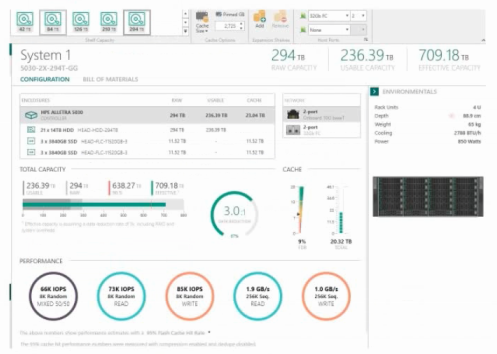
Which action plan would you suggest to correct the issue?
Detailed Explanatio n:
Rationale for Correct Answe r:
Frequent cache misses occur when the working dataset does not fit effectively in cache. Increasing the flash-to-disk ratio ensures a higher portion of hot data is served from flash media rather than backend disk, reducing cache miss penalties. This is the standard HPE recommendation for read-intensive workloads where cache is insufficient.
Distractors:
A: Adding shelves adds capacity, not cache-to-data efficiency.
B: Upgrading controllers increases CPU, but not necessarily cache efficiency.
C: Pinned cache is intended for metadata or specific workloads, not large-scale read caching.
Key Concept: Flash-to-disk ratio optimization reduces cache misses.
You need to evaluate a customer's virtual server environment to size an HCI solution based on HPE SimpliVity according to usage metrics over time. The environment consists of Dell servers and storage running VMware virtualization.
Which action can you use to gather the usage metrics of this setup?
Detailed Explanatio n:
Rationale for Correct Answe r:
For competitive or 3rd-party (non-HPE) environments like Dell + VMware, HPE CloudPhysics is the correct tool. The Observer VM is deployed into vCenter to gather real-world workload metrics (CPU, memory, storage I/O). These analytics can then be used for SimpliVity HCI sizing.
Distractors:
A: NinjaOnline SimpliVity Sizer requires input metrics, but it cannot directly collect from 3rd-party environments.
B: InfoSight sizing applies to HPE arrays, not competitive storage.
D: InfoSight for SimpliVity only monitors existing HPE SimpliVity clusters.
Key Concept: CloudPhysics Observer gathers competitive workload metrics feeds into SimpliVity sizing.
A customer is replacing their HPE 3PAR 8200 Peer Persistence setup with Alletra 6000. In a recent audit, they were warned that the Quorum Witness VM was missing security updates.
How would you respond regarding the new setup?
Detailed Explanatio n:
Rationale for Correct Answe r:
With Alletra and Primera Peer Persistence, the Quorum Witness is no longer a self-hosted VM. It is delivered as a cloud-based SaaS service managed by HPE. This eliminates customer responsibility for patching and ensures HPE automatically applies updates and security fixes. This resolves the audit concern.
Distractors:
A: Applies to older 3PAR environments, not Alletra/Primera.
C/D: Quorum Witness is no longer an appliance --- it is SaaS managed, so these don't apply.
Key Concept: Alletra Quorum Witness is SaaS-managed, removing patching responsibility.
Get access to all 50 verified questions with detailed answers.
Unlock All HPE7-J02 Questions