Limited-Time Offer: Enjoy 50% Savings! - Ends In 0d 00h 00m 00s Coupon code: 50OFF
Free Exam Questions

JN0-1103 Exam Questions & Answers

Design, Associate  •  Juniper

65 Questions 90 min Updated Jul 2026 99% Pass Rate
Get Full Access

100% money-back guarantee

About JN0-1103 Exam

The JN0-1103 Design, Associate certification exam is a fundamental credential for professionals seeking to validate their expertise in Juniper network design principles and architecture. This exam tests candidates' knowledge of core networking concepts, design methodologies, and Juniper product fundamentals including routing, switching, and security solutions. Aspiring network engineers, junior system administrators, and IT professionals looking to establish their foundation in enterprise network design should consider pursuing this certification. The JN0-1103 exam covers essential topics such as network topologies, design best practices, service deployment models, and Juniper's solutions architecture. Candidates can expect questions on network segmentation, high availability design, and basic security considerations that are critical for modern IT infrastructure.

To effectively prepare for the JN0-1103 certification exam, leveraging updated exam dumps and comprehensive practice tests is crucial for success. Quality study materials provide candidates with real-world scenario questions, detailed explanations, and performance tracking tools that simulate the actual exam environment. Practice tests help identify knowledge gaps, build confidence, and improve time management skills before the official examination. Using current exam dumps alongside official Juniper training resources and hands-on labs ensures candidates gain both theoretical knowledge and practical understanding. Regular practice with updated materials increases the likelihood of passing on the first attempt, ultimately saving time and resources while accelerating career advancement in network design and architecture roles.

Exam Topics & Objectives

Customer Network Design Requirements
Capacity planning
Securing the Network
Network Management or Reliability
Campus redundancy best practices
Junos OS on-box and off-box automation
Campus and Branch LAN Design
Campus design architectures
Campus and Branch WAN Design
Campus active/active and active/passive high availability (HA)
Data Center Network Design
Data center fabric architectures

4-Week Study Plan for JN0-1103

Week 1: Foundations & Customer Requirements

  • Study Customer Network Design Requirements and identify key design drivers (scalability, reliability, security, performance)
  • Review network assessment methodologies and customer needs analysis frameworks
  • Complete practice questions on gathering and validating customer requirements
  • Study Capacity Planning fundamentals: bandwidth calculations, growth projections, and resource dimensioning
  • Work through case studies on translating customer requirements into technical specifications
  • Review Juniper design documentation and best practice guides for campus networks
  • Take a diagnostic quiz on Week 1 topics to identify knowledge gaps

Week 2: Campus Design, Architecture & High Availability

  • Study Campus Design Architectures including access, aggregation, and core layers
  • Deep dive into Campus LAN Design principles, VLAN segmentation, and switching hierarchy
  • Learn Campus Redundancy Best Practices: spanning tree, loop prevention, and fault tolerance
  • Study Campus Active/Active HA architectures including configuration and failover mechanisms
  • Study Campus Active/Passive HA architectures and when to implement each model
  • Review Junos OS configuration for campus switching and routing protocols
  • Complete hands-on labs on campus topology design and HA configuration
  • Practice exam questions focusing on campus architecture scenarios

Week 3: Branch, WAN Design, Automation & Security

  • Study Campus and Branch WAN Design principles and connectivity options
  • Learn Branch LAN design patterns and integration with campus networks
  • Review Securing the Network: security zones, firewall policies, and threat mitigation
  • Study Junos OS On-Box Automation: commit scripts, event policies, and operational automation
  • Study Junos OS Off-Box Automation: Ansible integration, REST APIs, and configuration management tools
  • Complete labs on WAN design scenarios and branch connectivity configuration
  • Work through security design case studies and policy implementation
  • Practice automation configuration exercises using both on-box and off-box tools

Week 4: Data Center Design, Network Management & Exam Preparation

  • Study Data Center Network Design principles and requirements specific to DC environments
  • Deep dive into Data Center Fabric Architectures: spine-leaf topology, CLOS networks, and scalability
  • Review Network Management and Reliability concepts: monitoring, alerting, and high availability patterns
  • Study Junos OS management plane concepts and operational tools
  • Complete practice exams covering all four weeks of content with timed conditions
  • Review and reinforce weak areas identified from practice test results
  • Work through advanced scenario-based questions combining multiple topics
  • Final review of design best practices, configuration commands, and architecture decisions
  • Conduct final mock exam under exam conditions

Sample JN0-1103 Questions

Practice with real exam-style questions. Reveal answers to verify your knowledge.

Q1 MultipleChoice

You are considering changing an IBGP-based IP fabric design to one that is EBGP-based.

In this scenario, which two statements are correct about an EBGP-based design? (Choose two.)

Q2 MultipleChoice

You are asked to review a migration plan from standalone SRX to SRX chassis clusters that connect to the core network.

Which two types of interfaces will be required to support this design on the SRX Series devices? (Choose two.)

Q3 MultipleChoice

Which two versions of the Juniper SRX are appropriate for deployment in a virtual environment? (Choose two.)

Q4 MultipleChoice

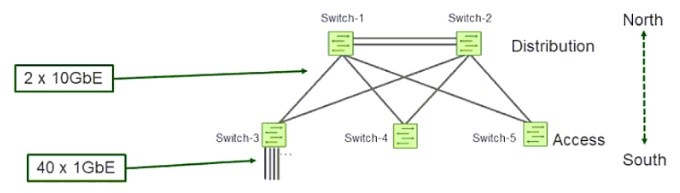
Click the Exhibit button.

Referring to the exhibit, which oversubscription ratio applies to Switch-3?

Q5 MultipleChoice

In which two instances should you use Postman as part of network automation? (Choose two.)

Get access to all 65 verified questions with detailed answers.

Unlock All JN0-1103 Questions

Frequently Asked Questions

The JN0-1103 is Juniper's Design, Associate level certification exam that validates foundational knowledge in designing Juniper networks. It covers basic networking concepts, Juniper products, and network design principles suitable for entry-level network engineers.

The exam covers fundamental networking concepts, Juniper routing and switching platforms, network design basics, security principles, and service deployment. It also includes topics related to cloud connectivity, automation, and industry-standard networking protocols.

The JN0-1103 exam typically consists of 65-75 multiple-choice questions and lasts 90 minutes. Candidates must achieve a score of approximately 70% or higher to pass the certification.

There are no strict prerequisites for the JN0-1103 exam, as it is designed for associate-level professionals. However, Juniper recommends having basic networking knowledge and some hands-on experience with networking concepts before attempting the certification.

Juniper provides official training courses, study guides, and documentation to help candidates prepare. Additionally, using practice exams, online study materials, and hands-on lab experience with Juniper equipment can significantly improve your chances of passing the exam.
Exam Details
  • Exam CodeJN0-1103
  • VendorJuniper
  • Total Questions65
  • Duration90 min
  • LanguageEnglish
  • Last UpdatedJul 19, 2026
4.9/5

Pass JN0-1103 First Time

Get all 65 exam questions with verified answers and 90-day free updates.

Buy Now & Pass
  • PDF + Practice Test Bundle
  • 90-Day Free Updates
  • 100% Money-Back Guarantee
  • Instant Download
  • 24/7 Customer Support
99% Pass Rate Trusted by 50,000+ IT professionals