JN0-364 Exam Questions & Answers
Service Provider Routing and Switching, Specialist • Juniper
100% money-back guarantee
Sample JN0-364 Questions
Practice with real exam-style questions, each with the verified correct answer and explanation.
What are three extension headers supported by IPv6? (Choose three.)
One of the most significant architectural improvements in IPv6 is the move from a complex, variable-length header (as seen in IPv4) to a streamlined, fixed-length base header of 40 bytes. Additional functionality that was previously handled by 'Options' in IPv4 is now moved to Extension Headers, which are inserted between the IPv6 base header and the upper-layer protocol (TCP/UDP).
According to Juniper Networks technical documentation and RFC 8200, the following are valid IPv6 Extension Headers:
Hop-by-Hop Options (Option B): This header carries optional information that must be examined by every node along the delivery path. It is used for features like the Router Alert and Jumbo Payload options.
Fragment (Option E): Unlike IPv4, where any router can fragment a packet, in IPv6, fragmentation is performed only by the source node. The Fragment header contains the information necessary for the destination to reassemble the packet (Offset, Identification, and More Fragments flag).
Destination Options (Option A): This header carries information intended only for the destination node. It can appear twice: once before a routing header and once after.
Why other options are incorrect:
Protocol (Option C): In IPv4, this was a field in the header. In IPv6, this is replaced by the Next Header field, which identifies the type of the following header (whether it's an extension header or the upper-layer protocol).
Header Checksum (Option D): This field was entirely removed in IPv6. IPv6 relies on the data link layer (Ethernet) and the transport layer (TCP/UDP) to perform error detection, significantly reducing the processing overhead for routers in the core of a service provider network.
Which IS-IS packet type will establish and maintain neighbor relationships?
In the IS-IS (Intermediate System to Intermediate System) protocol, communication between routers is performed using Protocol Data Units (PDUs). To discover neighbors and maintain adjacencies, IS-IS relies on the Hello PDU (IIH - IS-IS Hello).
According to Juniper Networks technical documentation, when IS-IS is enabled on an interface, the router begins transmitting Hello PDUs to a multi-destination address (multicast). These PDUs contain essential information such as the router's System ID, its configured Area Addresses, and its Level capability (Level 1, Level 2, or both). For two routers to become neighbors, they must exchange these Hello PDUs and agree on specific parameters, such as the MTU of the link and the hello/hold timers.
Once an adjacency is established, the Hello PDU serves as a 'keepalive' mechanism. If a router stops receiving Hello PDUs from a neighbor for a duration exceeding the Holding Time, it assumes the neighbor is down and flushes the associated Link-State PDUs (LSPs) from its database.
To clarify the other options:
Link-State PDU (Option A): These are used to distribute actual topology and reachability information, not to form adjacencies.
Partial Sequence Number PDU (Option C): PSNPs are used on point-to-point links to acknowledge the receipt of LSPs or to request missing LSPs.
Update PDU (Option D): This is not a standard IS-IS term; in IS-IS, updates are handled via the flooding of LSPs.
Exhibit:
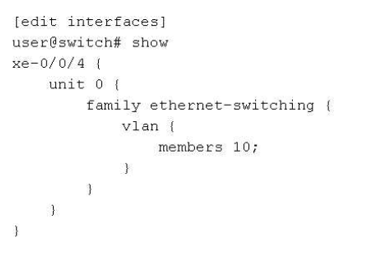
on a Juniper switch. It shows interfacexe-0/0/4withunit 0andfamily ethernet-switching. Under vlan, it lists members 10;`]
Referring to the exhibit, which two statements are true? (Choose two.)
In Junos OS for switching platforms, an interface is configured for Layer 2 bridging under the family ethernet-switching hierarchy. The way an interface handles VLAN traffic depends on its port mode: access or trunk.
According to Juniper Networks technical documentation, when an interface is configured simply with members <vlan-name/id>, it defaults to an access port. In an access port configuration:
The port is a member of only a single VLAN.
The port receives and sends untagged traffic (Option C). Any untagged frame arriving at this interface is implicitly associated with the configured VLAN member.
The interface does not expect or process 802.1Q tags in incoming frames.
In the exhibit, interface xe-0/0/4 has members 10;. In Junos, the members statement can reference either a VLAN name or a VLAN ID. However, when the configuration is shown as members 10; without further context of the specific ID mapping, the most precise interpretation of the CLI output provided is that the interface is a member of the VLAN named 10 (Option D). While '10' could be the numerical ID, Junos primarily maps members by their defined administrative name.
Why other options are incorrect:
Option A: Access ports do not receive tagged traffic; only trunk ports (which require the port-mode trunk and vlan members [ ... ] statements) are designed to process tagged frames.
Option B: While the VLAN named 10 likely has a VLAN ID of 10, the exhibit does not explicitly confirm the ID mapping. In Junos, a VLAN named '10' could technically have a different tag ID (e.g., VLAN 'Office' with ID 10). Option D is the more accurate direct reading of the displayed member configuration.
You must ensure that your routing platform with redundant REs continues to forward packets, even if one RE fails. Which technology would you use to accomplish this task?
For Juniper platforms equipped with dual Routing Engines (REs), the fundamental technology required to provide high availability during a hardware or software failure of the primary RE is Graceful Routing Engine Switchover (GRES).
According to Juniper Networks technical documentation, GRES allows the backup RE to stay in a 'hot' standby state. When GRES is enabled, the primary RE synchronizes critical state information with the backup RE, specifically the chassis state and the interface state. This synchronization includes the Packet Forwarding Engine (PFE) configuration.
When the primary RE fails, the backup RE takes over immediately. Because the PFE (which resides on the line cards) was already synchronized and is not restarted during the switchover, the router continues to forward packets that are already in flight or part of established flows. This prevents a complete network outage during an RE failover.
Comparison with other options:
NSB (Non-Stop Bridging - Option A): Focuses specifically on maintaining Layer 2 protocol states (like STP) during a switchover.
LAG (Link Aggregation - Option B): Provides redundancy for physical links, not the control plane or the RE.
BFD (Bidirectional Forwarding Detection - Option C): Is a protocol used for rapid detection of link or neighbor failures; it does not protect the RE or maintain forwarding during an internal switchover.
It is important to note that while GRES maintains the forwarding state, it does not by itself maintain the routing protocol state (adjacencies). To keep OSPF or BGP sessions from dropping during the switchover, GRES must be paired with Non-Stop Active Routing (NSR). However, as the question focuses on the core requirement of continuing to forward packets, GRES is the foundational technology.
Which two events cause a static route to be removed from a routing table? (Choose two.)
In Junos OS, a static route is a manually configured entry in the routing table. Unlike dynamic routes, which have built-in timers and aging mechanisms, static routes are generally 'permanent' as long as their conditions for validity are met.
1. Manual Removal (Option A):
Since static routes are explicitly defined by the administrator, the most direct way to remove one is through a configuration change. Using the delete routing-options static route
2. Next-Hop Reachability (Option B):
For a static route to be 'active' and installed in the forwarding table, its next-hop must be reachable. If a static route points to a specific physical interface or an IP address on a local segment, and that outbound interface becomes unavailable (e.g., the link goes 'Down'), the Junos kernel detects that the next-hop is no longer viable. Consequently, the route is marked as 'hidden' or 'inactive' and is removed from the active forwarding table to prevent traffic from being black-holed.
Why other options are incorrect:
Aging (Option C): Static routes do not have an expiration timer based on traffic. Even if no packet is sent for years, the route remains as long as the interface is up.
Remote Reachability (Option D): Standard static routes only track the status of the local interface or the immediate next-hop. They do not possess 'end-to-end' visibility. If a host two hops away fails, the local router has no way of knowing this via the static route itself. To achieve this level of tracking, features like RPM (Real-time Performance Monitoring) or BFD (Bidirectional Forwarding Detection) must be linked to the static route.
Get access to all 65 verified questions with detailed answers.
Unlock All JN0-364 Questions