JN0-352 Exam Questions & Answers
Enterprise Routing and Switching, Specialist • Juniper
100% money-back guarantee
Sample JN0-352 Questions
Practice with real exam-style questions, each with the verified correct answer and explanation.
You are asked to deploy nonstop active routing (NSR) on a dual-Routing Engine platform. In this scenario, what are two additional requirements for proper operation? (Choose two.)
Nonstop active routing is specifically engineered to be completely transparent to the rest of the network: rather than relying on neighboring routers to preserve state during a Routing Engine switchover the way graceful restart does, NSR keeps a fully synchronized instance of the routing protocol process (rpd) running continuously on the backup Routing Engine, mirroring protocol adjacencies, the RIB, and session state in real time. Because neighbors never observe a session reset or restart signal during an NSR-driven switchover, there is no dependency on those neighbors supporting or enabling graceful restart extensions at all --- this is the core architectural advantage that distinguishes NSR from GR and is precisely why the first and third answer choices are incorrect distractors. What NSR does require locally is Graceful Routing Engine Switchover (GRES) enabled first, since NSR is built as an extension on top of GRES and depends on it to synchronize kernel and interface state between the two Routing Engines before protocol-level synchronization can occur. Additionally, Juniper's official guidance mandates that both Routing Engines run the identical Junos OS software version; mismatched versions between the primary and backup Routing Engine can introduce incompatible internal data structures or feature behavior during state replication, jeopardizing the integrity of a switchover and is explicitly called out as a hard operational requirement rather than a mere best practice. Reference topics: Junos Enterprise Routing -- High Availability, Nonstop Active Routing Requirements and GRES Dependency.
Refer to Exhibit:
Click the Exhibit button.
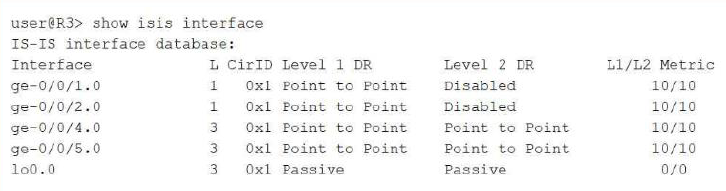
Which two statements about the output shown in the exhibit are correct? (Choose two.)
The L column in this output identifies which IS-IS levels are active on each interface, using the standard bitmask where 1 represents Level 1 only and 3 represents both Level 1 and Level 2 combined. Interface ge-0/0/2.0 shows an L value of 1 and its Level 2 DR field explicitly reads Disabled, meaning Level 2 has not been enabled on that circuit at all; consequently no Level 2 adjacency can ever form there, regardless of what the neighboring router advertises, which confirms that statement as correct. The lo0.0 loopback interface shows Passive under both the Level 1 DR and Level 2 DR columns. A passive IS-IS interface is deliberately excluded from adjacency formation --- no IIH PDUs are sent or expected on it --- but its associated prefix is still injected into the router's own LSP and flooded throughout the area, which is precisely why loopbacks are configured as passive: to guarantee the router ID/loopback prefix is reachable network-wide without wasting adjacency overhead on an interface with no real neighbor. This confirms that R3 advertises its loopback address, while ruling out the claim that the loopback is used to form an adjacency. Regarding designated routers, all circuits shown here report 'Point to Point' rather than an actual DR system ID, because DR election in IS-IS is a construct exclusive to broadcast (LAN) circuits; point-to-point circuits never elect a DR, so the first statement is false. Reference topics: Junos Enterprise Routing -- IS-IS, Interface Levels and Passive Interfaces.
You are configuring a GRE tunnel between Router A (192.168.1.1) and Router B (192.168.2.1) to connect two isolated networks. The tunnel interfaces (gr-0/0/0) need to support IPv4 traffic.
In this scenario, which configuration ensures the tunnel endpoints are correctly defined and reachable?
A functioning GRE tunnel interface in Junos requires, at minimum, both a tunnel source address and a tunnel destination address configured together under the tunnel statement of the gr- logical unit, since these two values together define the outer, delivery-layer IP header that will encapsulate every passenger packet sent through the tunnel; the source identifies which of the router's own addresses will originate the encapsulated traffic, and the destination identifies the remote tunnel endpoint the encapsulated traffic must be routed toward across the underlying IP network. The first option correctly supplies both required values in a single, complete statement --- source 192.168.1.1 (Router A's own address) and destination 192.168.2.1 (Router B's address) --- fully defining the tunnel's endpoints and ensuring the encapsulation and route-resolution process can succeed. The fourth option supplies only the destination and omits the source entirely, which is an incomplete configuration; without an explicit source, Junos cannot always reliably determine which local address to use for encapsulation, particularly on multi-address or multi-interface routers, and the tunnel configuration is left non-deterministic or non-functional as shown. The second option enables the IPv6 protocol family on the tunnel's logical unit, which is irrelevant to a scenario explicitly requiring IPv4 passenger traffic support. The third option attempts to assign a family inet address directly using one of the underlying tunnel endpoint addresses, which conflates the tunnel's own transport addressing with logical-unit protocol addressing and does not by itself establish the required source/destination tunnel definition. Reference topics: Junos Enterprise Routing -- Tunneling, Configuring GRE Tunnel Source and Destination.
How does BGP prevent routing loops between internal peers?
BGP employs two distinct loop-prevention mechanisms depending on whether peers are external or internal to the same autonomous system. Between external peers (EBGP), loop prevention relies on the AS path attribute: every time a route crosses an AS boundary, the local AS number is prepended to the path, and a router rejects any incoming route whose AS path already contains its own AS number, since that would indicate the route has looped back around. Between internal peers (IBGP) within the same AS, however, the AS path attribute never changes, because IBGP does not add AS numbers as routes are readvertised internally --- meaning AS path alone cannot detect an internal loop. Instead, IBGP enforces a strict split-horizon-style rule: a router that learns a route via IBGP must never readvertise that route to another IBGP peer. This rule guarantees that every IBGP speaker within the AS must be directly peered with every other IBGP speaker (a logical full mesh) in order for all routers to receive all routes, since no IBGP router will relay IBGP-learned routes onward on another router's behalf. This full-mesh requirement is precisely why techniques such as route reflection and confederations were later developed --- they preserve the same loop-prevention guarantee while relaxing the physical full-mesh peering burden. VRRP and BFD serve entirely unrelated purposes (gateway redundancy and fast failure detection, respectively) and play no role in BGP loop prevention. Reference topics: Junos Enterprise Routing -- BGP, IBGP Split-Horizon and the Full-Mesh Requirement.
[Exhibit]
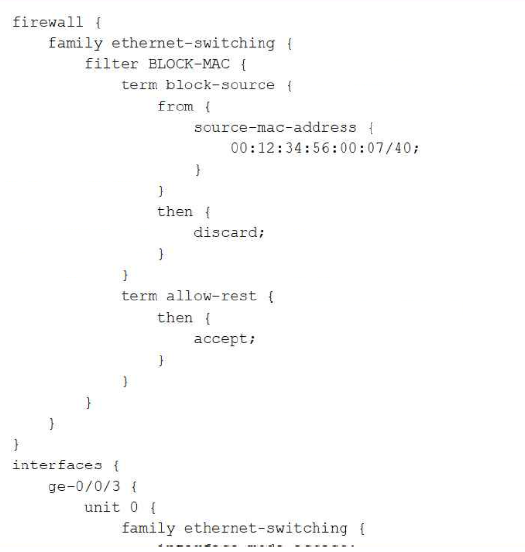
You need to apply a Layer 2 firewall filter on a Juniper Networks EX Series Switch to block traffic from the source MAC address 00:12:34:56:00:07 entering the switch on ge-0/0/3. After committing the configuration, traffic from the MAC address still passes through.
Referring to the exhibit, which statement is correct in this scenario?
The intent of this filter is to match and discard traffic from one single, specific host MAC address, which requires the source-mac-address match condition to reference the complete, exact 48-bit address using an explicit /48 mask (or no mask at all, which Junos treats as an implicit full match) so that only that one precise address is matched. As configured, the term instead specifies a /40 mask on 00:12:34:56:00:07, meaning only the first 40 bits (the first five octets, 00:12:34:56:00) are actually significant to the match, while the sixth octet is effectively wildcarded across its full range; this produces an imprecise, overly broad match criterion rather than the single-host match the administrator intended, and is a common configuration mistake that undermines the predictability and correctness of MAC-based filtering. The lesson tested here is that source and destination MAC address match conditions in Junos firewall filters must be specified with the correct, deliberate, and explicit prefix length appropriate to the intended scope --- typically /48 for a single exact host --- rather than an arbitrary or miscalculated mask value. Firewall filters under family ethernet-switching are fully capable of matching on both source-mac-address and destination-mac-address, which rules out that option entirely. Layer 2 MAC-based filters function correctly on both access and trunk interface modes, so interface type is not a limiting factor here. There is no indication in the exhibit that the filter's application direction (input versus output) is reversed. Reference topics: Junos Enterprise Switching -- Layer 2 Security, MAC Address Match Conditions and Prefix Length Precision.
Get access to all 65 verified questions with detailed answers.
Unlock All JN0-352 Questions