JN0-363 Exam Questions & Answers
Service Provider Routing and Switching, Specialist • Juniper
100% money-back guarantee
About JN0-363 Exam
The JN0-363 Service Provider Routing and Switching Specialist certification exam is designed for networking professionals seeking to validate their expertise in managing complex service provider environments. This rigorous Juniper Networks certification assessment focuses on advanced routing protocols, switching technologies, and network architecture principles essential for professionals deploying and maintaining large-scale carrier networks. Candidates will encounter in-depth questions covering OSPF, BGP, MPLS, VLANs, and service provider-specific configurations that demonstrate practical knowledge required in today's demanding telecom landscape. The JN0-363 exam serves as a critical credential for engineers and architects aiming to advance their careers in service provider infrastructure roles.
Network administrators, systems engineers, and IT professionals with substantial hands-on experience in service provider environments should pursue the JN0-363 certification to establish themselves as subject matter experts. Utilizing updated exam dumps and comprehensive practice tests significantly enhances preparation strategies by familiarizing candidates with the actual exam format, time constraints, and challenging question types they'll encounter. Quality study materials provide detailed explanations for each topic, identify knowledge gaps, and build confidence before the assessment. Incorporating practice tests into your study regimen ensures you master complex concepts like service provider architectures and advanced routing implementations, ultimately increasing your likelihood of achieving a passing score and earning this prestigious Juniper certification.
Exam Topics & Objectives
4-Week Study Plan for JN0-363
Week 1: Foundational Routing & OSPF Mastery
- Study Protocol-Independent Routing fundamentals: routing tables, administrative distance, route preferences, and metric calculations
- Configure static routes and default routes in Junos; understand how they interact with dynamic protocols
- Master OSPF basics: areas, LSA types, flooding mechanism, and SPF algorithm
- Practice OSPF configuration on Juniper devices: area setup, interface enablement, and neighbor adjacency
- Analyze OSPF cost calculations and metric manipulation for path control
- Complete 2-3 hands-on labs configuring multi-area OSPF topologies
- Review route summarization and stub area configurations
- Take practice quiz on Protocol-Independent Routing and OSPF concepts
Week 2: Advanced Routing Protocols - IS-IS & BGP Foundation
- Learn IS-IS protocol structure: PDUs, levels, and TLV encoding
- Configure IS-IS on Juniper devices with Level 1 and Level 2 hierarchies
- Compare IS-IS and OSPF: advantages, scalability, and deployment scenarios
- Study BGP fundamentals: ASN, neighbor relationships, and message types
- Practice BGP configuration: eBGP and iBGP peering, route advertisement, and filtering
- Understand BGP path selection process and route preference mechanisms
- Configure route reflectors and confederations for iBGP scalability
- Analyze BGP community attributes and route policies
- Complete hands-on lab integrating OSPF, IS-IS, and BGP in multi-protocol network
Week 3: Layer 2, Switching, High Availability & MPLS
- Master VLAN configuration and trunk protocols on Juniper switches
- Study Spanning Tree Protocol: RSTP, PVST, and MSTP variants
- Configure STP on Juniper devices; practice root bridge election and port role assignment
- Learn Layer 2 bridging fundamentals: MAC address learning, flooding, and loop prevention
- Study MPLS basics: labels, label switching, and LSP establishment
- Configure LDP and RSVP-TE for MPLS path setup
- Understand VPN applications: Layer 3 VPNs and VPLS concepts
- Study High Availability mechanisms: graceful restart, NONSTOP forwarding, and BFD
- Practice configuring BFD for rapid failure detection on routing protocols
- Complete integrated lab with VLAN, STP, and MPLS configurations
Week 4: IPv6, Tunnels & Exam Preparation
- Master IPv6 address architecture: unicast, multicast, link-local, and global scope addressing
- Configure IPv6 on Juniper interfaces and routing protocol adjacencies
- Study IPv6 neighbor discovery and stateless autoconfiguration mechanisms
- Learn tunnel technologies: 6to4, IPv6 over IPv4, and GRE tunnels
- Configure IP-IP tunnels and automatic tunnels on Juniper devices
- Practice traffic engineering with tunnels and MPLS interactions
- Review all protocol interactions: routing convergence, failover scenarios, and policy application
- Run comprehensive practice exam covering all 10 topics
- Perform gap analysis and focused review on weak areas
- Complete final hands-on integration lab simulating production network scenarios
Sample JN0-363 Questions
Practice with real exam-style questions. Reveal answers to verify your knowledge.
Which new field is added to an IPv6 header as compared lo IPv4?
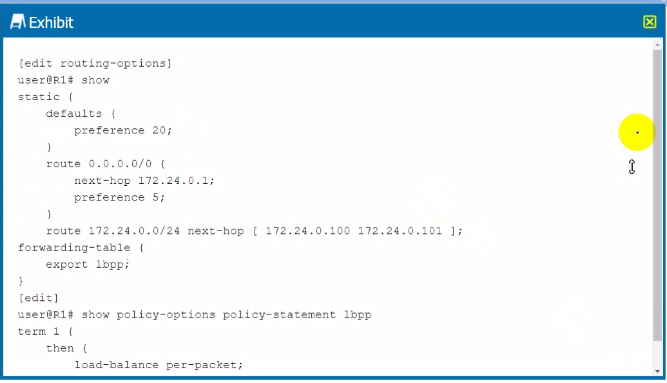
Exhibit

Which type of load balancing is shown in the exhibit?
You want to see a detailed list of all established BGP sessions. In this scenario, what would be a valid command to accomplish this task?
Which statement describes integrated routing and bridging (IRB) interfaces?
Which two statements are correct about the way that BGP propagates routes by default? (Choose two.)
Get access to all 86 verified questions with detailed answers.
Unlock All JN0-363 Questions