JN0-664 Exam Questions & Answers
Service Provider Routing and Switching, Professional Exam • Juniper
100% money-back guarantee
About JN0-664 Exam
The JN0-664 Service Provider Routing and Switching Professional Exam is a comprehensive certification from Juniper Networks designed to validate advanced expertise in routing and switching technologies within service provider environments. This exam tests candidates' knowledge of complex network architectures, BGP implementations, MPLS protocols, and advanced switching configurations critical for managing large-scale service provider networks. The JN0-664 certification demonstrates proficiency in deploying and optimizing enterprise and carrier-grade network solutions using Juniper equipment and platforms.
Network engineers, service provider professionals, and systems architects pursuing advanced career growth should consider taking the JN0-664 exam. To achieve certification success, candidates benefit significantly from utilizing updated exam dumps and practice tests that mirror actual exam scenarios and question formats. Quality study materials provide hands-on experience with real-world configurations, help identify knowledge gaps, and build confidence before the actual examination. Combined with official Juniper documentation and practical lab experience, comprehensive practice tests ensure candidates are thoroughly prepared to pass the JN0-664 exam and earn their Professional-level certification in service provider routing and switching technologies.
Exam Topics & Objectives
4-Week Study Plan for JN0-664
Week 1: Routing Fundamentals and OSPF
- Study OSPF protocol fundamentals: LSA types, areas, and router types
- Configure and troubleshoot OSPF in single-area and multi-area topologies
- Practice OSPF authentication methods and neighbor adjacency formation
- Lab: Deploy OSPF with different area types (backbone, standard, stub, NSSA)
- Review OSPF metric calculation and path selection mechanisms
- Complete practice questions on OSPF convergence and optimization
- Study OSPF virtual links and sham links for non-contiguous areas
Week 2: IS-IS, BGP Fundamentals, and BGP Implementation
- Study IS-IS protocol architecture: Level 1 and Level 2 routing
- Configure IS-IS in single and multi-level domains
- Lab: Implement IS-IS network with proper hierarchy and TLV management
- Review BGP fundamentals: eBGP vs iBGP, path selection, and attributes
- Configure BGP peer relationships and neighbor adjacency
- Study BGP attribute types (origin, AS-path, local preference, MED)
- Practice BGP route filtering and manipulation techniques
- Lab: Deploy BGP in multi-AS environment with route redistribution
Week 3: Advanced BGP, Class of Service, and IP Multicast
- Study BGP advanced features: communities, route reflectors, and confederations
- Lab: Configure BGP route reflectors and test convergence scenarios
- Review Class of Service (CoS) concepts: DSCP, EXP, and forwarding classes
- Configure QoS policies and traffic shaping on Junos devices
- Study IP Multicast fundamentals: PIM, IGMP, and multicast tree building
- Lab: Deploy PIM-SM/PIM-DM multicast trees in test network
- Configure multicast boundaries and group filtering
- Practice troubleshooting multicast forwarding state and RPF checks
Week 4: Layer 3 VPNs, Layer 2 VPNs, and Final Review
- Study Layer 3 VPN concepts: MPLS, LDP, and VRF implementation
- Configure MPLS forwarding and LDP neighbor adjacency
- Lab: Deploy PE-CE routing with BGP and static routes in VPN topology
- Study Layer 2 VPN types: VPLS, L2VPN, and circuit cross-connect
- Lab: Configure VPLS and EVPN for multi-site Layer 2 connectivity
- Review Layer 2 VPN packet encapsulation and label stacking
- Practice end-to-end VPN troubleshooting scenarios
- Take full-length practice exam covering all seven topics
- Review weak areas and complete targeted labs for exam readiness
Sample JN0-664 Questions
Practice with real exam-style questions. Reveal answers to verify your knowledge.
Your organization manages a Layer 3 VPN for multiple customers To support advanced route than one BGP community on advertised VPN routes to remote PE routers.
Which routing-instance configuration parameter would support this requirement?
Exhibit

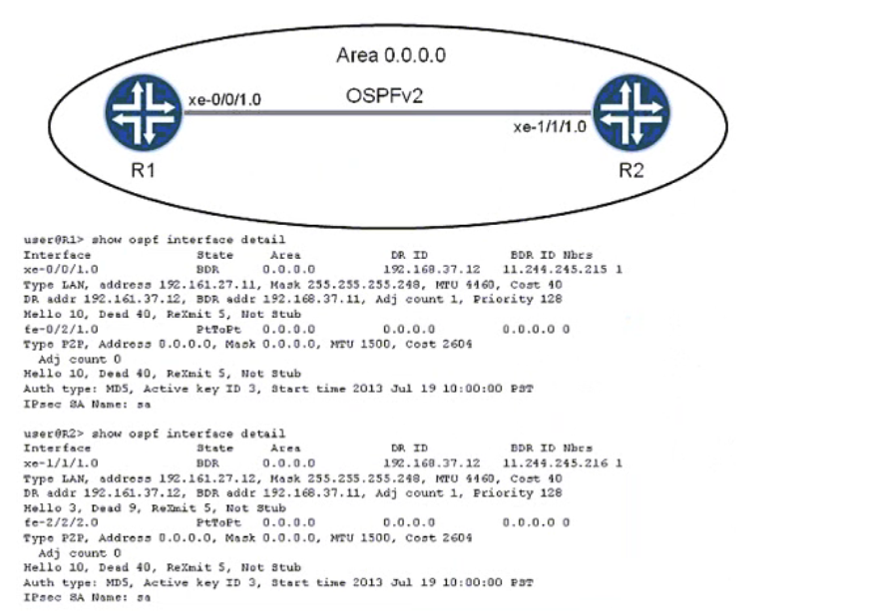
Which two statements are true about the OSPF adjacency displayed in the exhibit? (Choose two.)
Exhibit
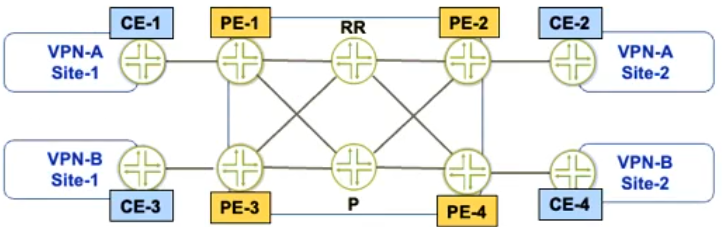
Referring to the exhibit, PE-1 and PE-2 are getting route updates for VPN-B when neither of them service that VPN
Which two actions would optimize this process? (Choose two.)
Which statement is true regarding BGP FlowSpec?
Exhibit
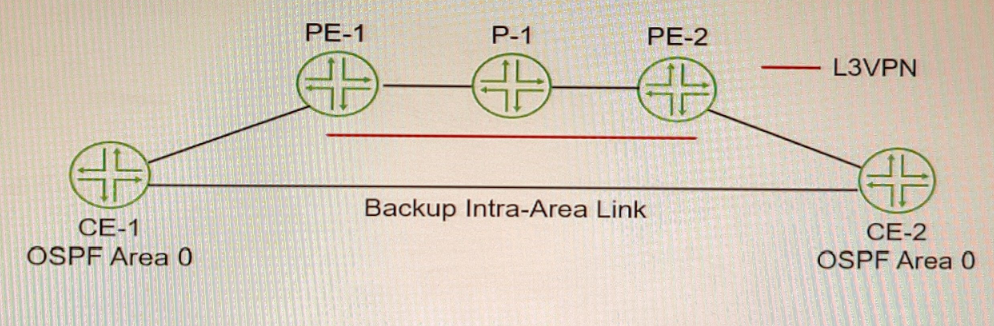
You must ensure that the VPN backbone is preferred over the back door intra-area link as long as the VPN is available. Referring to the exhibit, which action will accomplish this task?
Get access to all 96 verified questions with detailed answers.
Unlock All JN0-664 Questions