JN0-683 Exam Questions & Answers
Data Center Professional • Juniper
100% money-back guarantee
Sample JN0-683 Questions
Practice with real exam-style questions, each with the verified correct answer and explanation.
Exhibit.
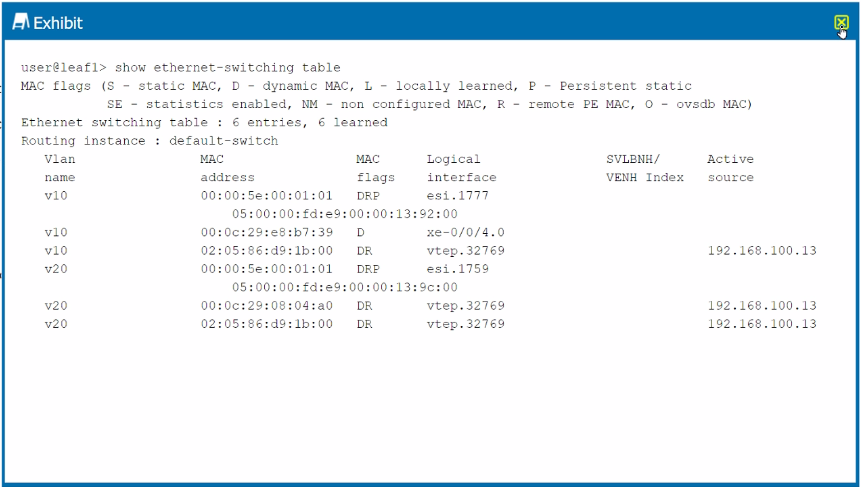
Referring to the exhibit, why is the active source field blank for the entry that uses the 00:0c:29:e8:b7:39 MAC address?
In this scenario, the active source field is blank for the MAC address 00:0c:29:e8:b7:39, indicating an issue with how this MAC entry is being processed within the EVPN/VXLAN environment.
Step-by-Step Analysis:
Understanding the MAC Entry:
The active source field should normally indicate the source of the route advertisement for a specific MAC address within the EVPN. If it is blank, it suggests that there is a problem with how this entry is being learned or propagated.
Possible Issues:
Option A: If the EVPN route for this MAC address does not have a valid next hop, the entry might exist in the MAC table, but it will not have a valid path for forwarding, leading to a blank active source.
Option B: If the ARP lookup had failed, the entry might not even appear in the MAC table. However, the entry does exist, suggesting that ARP is not the primary issue here.
Option C: If the host were locally connected, the active source should reflect a local interface, but the field is blank, ruling out local connection as the cause.
Option D: Multicast EVPN routes typically do not appear in this manner in the MAC table, and this would not cause the active source to be blank.
Conclusion: The most logical explanation is that the EVPN route for this host exists but does not have a valid next hop, leading to the absence of an active source. This is consistent with how EVPN routing tables work in a VXLAN environment, where the lack of a valid next hop would prevent proper route advertisement and forwarding for the specific MAC address.
What are three actions available tor MAC move limiting? (Choose three.)
MAC Move Limiting:
MAC move limiting is a security feature used in network switches to detect and mitigate rapid changes in MAC address locations, which could indicate a network issue or an attack such as MAC flapping or spoofing.
When a MAC address is learned on a different interface than it was previously learned, the switch can take various actions to prevent potential issues.
Available Actions:
A . drop: This action drops packets from the MAC address if it violates the move limit, effectively blocking communication from the offending MAC address.
D . log: This action logs the MAC move event without disrupting traffic, allowing network administrators to monitor and investigate the event.
E . shutdown: This action shuts down the interface on which the MAC address violation occurred, effectively stopping all traffic on that interface to prevent further issues.
Other Actions (Not Correct):
B . filter: Filtering is not typically associated with MAC move limiting; it generally refers to applying ACLs or other mechanisms to filter traffic.
C . enable: This is not an action related to MAC move limiting, as it does not represent a specific reaction to a MAC move event.
Data Center Reference:
MAC move limiting is crucial for maintaining network stability and security, particularly in environments with dynamic or large-scale Layer 2 networks where MAC addresses might frequently change locations.
You want to ensure that VXLAN traffic from the xe-0/0/12 interlace is being encapsulated by logical vlep.32770 and sent to a remote leaf device in this scenario, which command would you use to verify that traffic is flowing?
VXLAN Traffic Verification:
To ensure VXLAN traffic from the xe-0/0/12 interface is correctly encapsulated by the logical vtep.32770 and sent to a remote leaf device, it is essential to monitor the relevant interface statistics.
The command show interfaces terse vtep.32770 statistics provides a concise overview of the traffic statistics for the specific VTEP interface, which can help verify whether traffic is being correctly encapsulated and transmitted.
This command is particularly useful for quickly checking the traffic counters and identifying any potential issues with VXLAN encapsulation or transmission.
It allows you to confirm that traffic is flowing as expected, by checking the transmitted and received packet counters.
Data Center Reference:
Monitoring interface statistics is a crucial step in troubleshooting and validating network traffic, particularly in complex overlay environments like EVPN-VXLAN.
You are asked to build redundant gateways in your EVPN-VXLAN environment, but you must conserve address space because these gateways must span across seven PES. What should you implement on the PEs lo satisfy these requirements?
Redundant Gateways in EVPN-VXLAN:
In an EVPN-VXLAN environment, providing redundant gateway functionality typically involves the use of Anycast Gateway. This allows multiple PEs (Provider Edge devices) to use the same IP address and MAC address for the gateway, enabling seamless failover and redundancy without IP conflicts.
Conserving Address Space:
Using the same IP address across multiple PEs conserves address space because only one IP address is needed for the gateway function, regardless of the number of PEs. The shared MAC address ensures that ARP resolution and forwarding behavior are consistent across all the PEs.
Conclusion:
Option C: Correct---Using IRB interfaces with the same IP and MAC address across all PEs satisfies the need for redundancy while conserving address space.
Options A, B, and D introduce unnecessary complexity or do not fully utilize the efficient Anycast Gateway approach, which is best practice for conserving IP space and providing redundancy.
You are selling up an EVPN-VXLAN architecture (or your new data center. this initial deployment will be less than 50 switches: however, it could scale up to 250 switches over time supporting 1024 VLANs. You are still deciding whether to use symmetric or asymmetric routing.
In this scenario, which two statements are correct? (Choose two.)
Symmetric vs. Asymmetric Routing in EVPN-VXLAN:
Symmetric Routing: Traffic enters and exits the VXLAN network through the same VTEP, regardless of the source or destination. This approach simplifies routing decisions, especially in large networks, and is generally more scalable.
Asymmetric Routing: The routing occurs on the egress VTEP. This method can be simpler to deploy in smaller environments but becomes complex as the network scales, particularly with larger numbers of VNIs and VLANs.
Correct Statements:
C . Symmetric routing supports higher scaling numbers: Symmetric routing is preferred in larger EVPN-VXLAN deployments because it centralizes routing decisions, which can be more easily managed and scaled.
D . Asymmetric routing routes traffic on the egress switch: This is accurate, as asymmetric routing means the routing decision is made at the final hop, i.e., the egress VTEP before the traffic reaches its destination.
Incorrect Statements:
A . Symmetric routing needs an extra VLAN with an IRB interface for each L3 VRF instance: This is not accurate. Symmetric routing does not require an extra VLAN per VRF; rather, it uses the same VLAN/VNI across the network, simplifying routing and VLAN management.
B . Asymmetric routing is easier to monitor because of the transit VNI: Asymmetric routing is not necessarily easier to monitor; in fact, it can add complexity due to the split routing logic between ingress and egress points.
Data Center Reference:
The choice between symmetric and asymmetric routing in an EVPN-VXLAN environment depends on network size, complexity, and specific operational requirements. Symmetric routing is generally more scalable and easier to manage in large-scale deployments.
Get access to all 65 verified questions with detailed answers.
Unlock All JN0-683 Questions