NSE6_FSM_AN-7.4 Exam Questions & Answers
Fortinet NSE 6 - FortiSIEM 7.4 Analyst • Fortinet
100% money-back guarantee
Sample NSE6_FSM_AN-7.4 Questions
Practice with real exam-style questions, each with the verified correct answer and explanation.
Which analytics search can be used to apply a user and entity behavior analytics (UEBA) tag to an event for a failed login by the user JSmith?
The best matching analytics search is Username CONTAIN smit. The FortiSIEM Analytics lesson explains keyword and attribute matching by using the CONTAIN operator for searching values inside raw logs or attributes. The Study Guide gives a direct example of FortiSIEM translating keyword logic into a condition such as ''Raw Event Log CONTAIN TCP.'' That shows the operator is designed for substring-style matching rather than full-value equality. For a user such as JSmith, the string fragment smit is contained inside the username value, so the condition can match events where the username appears as JSmith, jsmith, or possibly in a longer identity string such as a domain-qualified username. Option A is wrong because smith is not the complete username and uses an equality-style comparison. Option B is wrong because it excludes usernames ending in jsmith. Option C uses the wrong operator form for this context. Therefore, the practical FortiSIEM analytics condition that can match the target failed-login event is Username CONTAIN smit.
Refer to the exhibit.
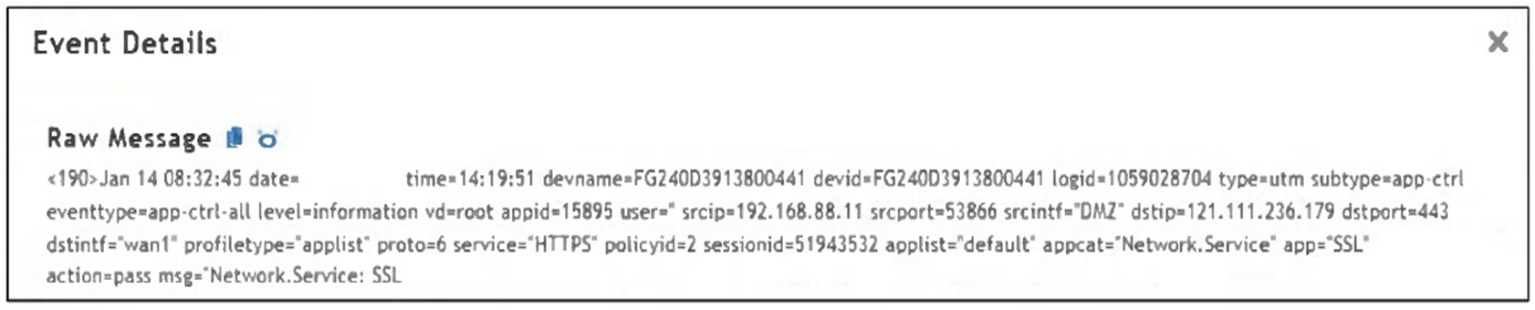
Which value would you expect the FortiSIEM parser to use to populate the Application Name field?
The correct answer is C. SSL. FortiSIEM receives raw logs, processes them through parsers, normalizes the extracted fields, classifies the event, and stores the structured data. The Study Guide explains the FortiSIEM process flow: data is collected, processed by the parsing engine, normalized, classified, and then stored. It further states that normalization extracts individual fields from raw events and maps those fields to a common schema. The FortiSIEM 7.4 User Guide describes a parser as a file containing instructions for the parser module to convert a raw log into event attributes. In the exhibit, the raw FortiGate log includes values such as profiletype='applist', appcat='Network.Service', and app='SSL'. The field that directly represents the application value is app='SSL'. Therefore, the parser would use SSL to populate the normalized Application Name field. applist describes the profile type, Network.Service is the application category, and wan1 is the interface, not the application name.
Which run mode takes the most time to perform machine learning tasks?
The correct answer is Local Auto. The uploaded answer was right, but its explanation was sloppy because it incorrectly described Local mode as the most time-consuming mode. In FortiSIEM machine learning, Local Auto mode selects the best algorithm by evaluating multiple candidate algorithms. The User Guide states that in Local Auto mode, ''FortiSIEM picks the best algorithm'' and that the Max Run Time parameter limits how long the job can run; longer runtime can produce better results. That is why Local Auto can take the most time. Forecasting and Regression are task types, not run modes.
Refer to the exhibit.
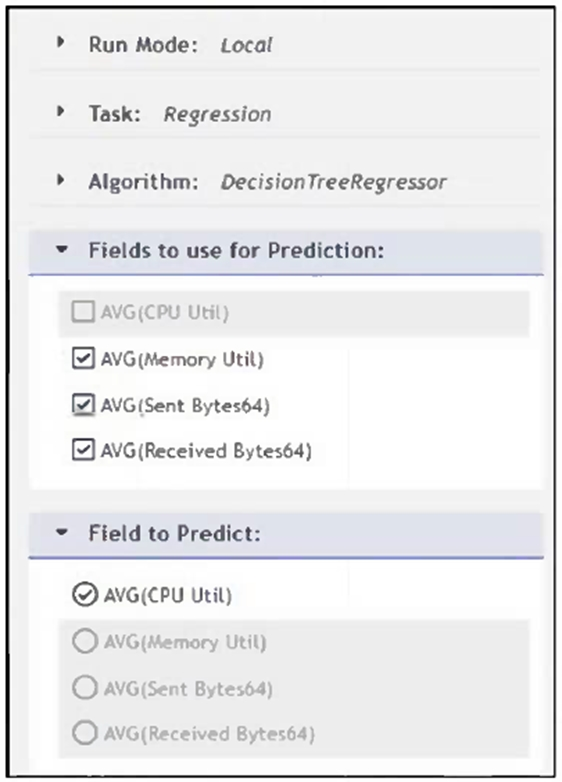
What will happen when a device being analyzed by the machine learning configuration shown in the exhibit has consistently high memory utilization?
The exhibit shows a machine learning Regression configuration. In FortiSIEM regression, selected numerical fields are used as predictors, and another field is selected as the value to predict. The FortiSIEM 7.4 User Guide's Machine Learning section lists Regression separately and describes the training workflow, including selecting fields used by the algorithm. The exhibit shows Memory Utilization, Sent Bytes, and Received Bytes selected under Fields to use for Prediction, while CPU Utilization is selected under Field to Predict. This means Memory Utilization is an input variable used by the model. If memory utilization is consistently high during training or retraining, that higher value becomes part of the learned model pattern. FortiSIEM does not automatically trigger a high-memory incident merely because a regression input value is high; an incident would require inference behavior and an anomaly action or rule configuration. Option C is also wrong because FortiSIEM does not dynamically lower a CPU trigger threshold just because memory is high. The correct behavior is model update based on the higher observed input value.
Refer to the exhibit.
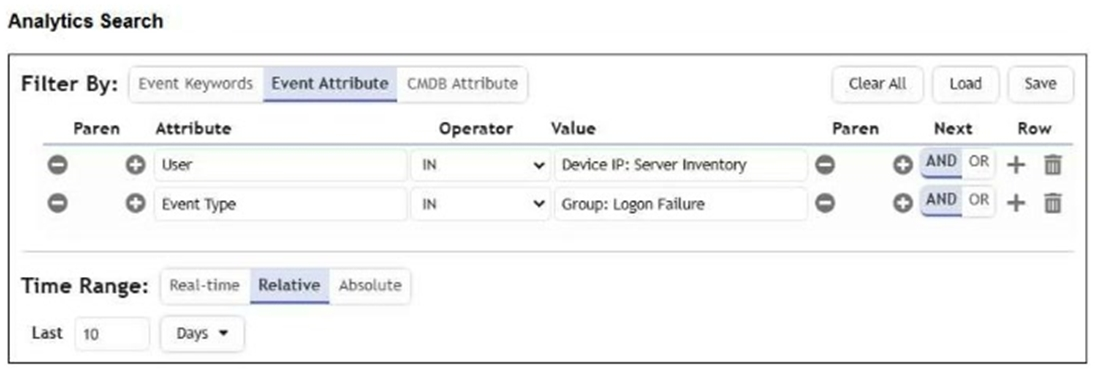
The analyst is troubleshooting the analytics query shown in the exhibit.
Why is this search not producing any results?
The search fails because nested analytics queries require the outer query attribute type to match the inner query display-column data type. The FortiSIEM Study Guide explicitly explains this rule in the Nested Query section: ''Another important aspect to understand is that the data value types must match.'' It further explains that each inner query display column has a data value type, such as IP, string, or integer, and the outer query attribute must match that type. The FortiSIEM 7.4 User Guide states the same operational requirement: for a nested query to work correctly, ''the data type of the filter attribute in the outer query must match up with the data type of one certain display column in the inner query.'' Therefore, if the inner query returns a string attribute but the outer query compares it against an IP-type attribute, FortiSIEM cannot produce a valid match. The issue is not the time range, not the use of User and Event Type together, and not the Boolean operator. It is an attribute type mismatch between the query and subquery.
Get access to all 48 verified questions with detailed answers.
Unlock All NSE6_FSM_AN-7.4 Questions