NSE6_FSR_AN-7.6 Exam Questions & Answers
Fortinet NSE 6 - FortiSOAR 7.6 Analyst • Fortinet
100% money-back guarantee
Sample NSE6_FSR_AN-7.6 Questions
Practice with real exam-style questions, each with the verified correct answer and explanation.
Refer to the exhibit.
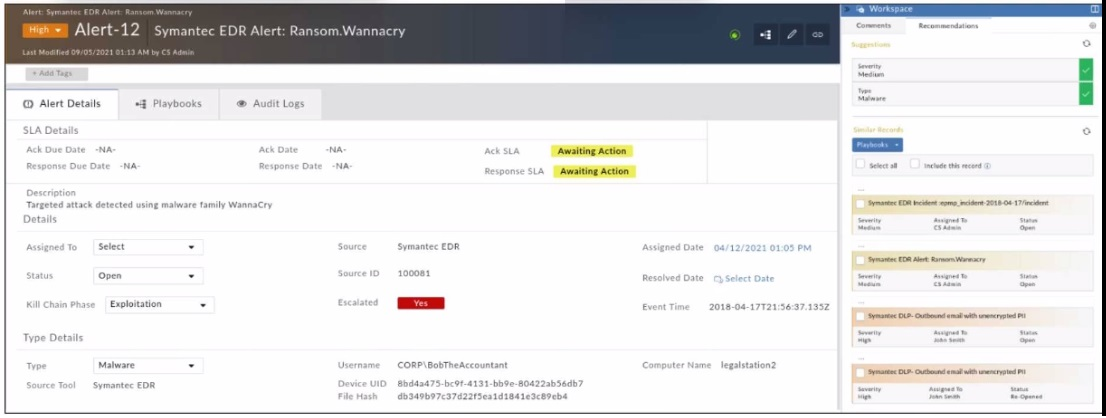
Which two statements about the recommendation engine are true? (Choose two.)
The Recommendation Engine in FortiSOAR is designed to assist in alert triage by suggesting values for certain fields based on historical data and machine learning models. In this case, the engine is trained to predict both the Severity and Type fields, suggesting values that align with past incidents and threat intelligence. Although the current alert severity is High, the recommendation engine has suggested adjusting it to Medium based on the pattern of similar past alerts, indicating a less critical threat level than initially perceived. This functionality helps analysts by providing data-driven insights, which can optimize alert handling and resource allocation.
Which product is essential to level 3 of the SOC automation model?
The SOC automation maturity model progresses through levels: Level 1 focuses on tool integration, Level 2 adds orchestration, and Level 3 emphasizes advanced intelligence-driven automation with predictive and adaptive capabilities. FortiSOAR (or related Fortinet products) serves as the orchestration and automation platform essential to Level 3. However, to reach Level 3 specifically, you also need AI/ML capabilities—typically provided through FortiAI or integrated machine learning modules that enable predictive incident detection, automated response optimization, and intelligent triage. The essential product at Level 3 is generally FortiSOAR paired with machine learning/AI intelligence capabilities.
Refer to the exhibit.
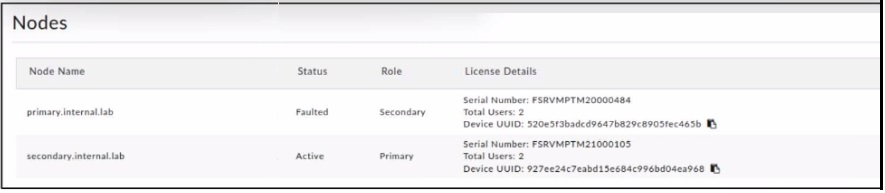
The former primary node was relegated to the secondary rote but is stuck in the Faulted state.
Which two steps must you take to restore operation in the high availability (HA) cluster? (Choose two.)
In a FortiSOAR HA cluster, if the former primary node is relegated to a secondary role but is stuck in a Faulted state, it indicates that the node has lost sync or faced a failure during a role change. To restore its functionality, first, you should remove it from the cluster using the csadm ha leave-cluster command. Once it has left the cluster, you can use the csadm ha join-cluster command to re-add the node as a secondary node. This process will allow it to sync back up with the cluster and resume its role as intended.
An administrator wants to collect and review all FortiSOAR log tiles to troubleshoot an issue. Which two methods can they use to accomplish this? (Choose two.)
Administrators can collect and review FortiSOAR logs for troubleshooting in two primary ways. First, they can download logs directly from the GUI, which provides access to various logs through an intuitive interface. Secondly, using the command-line interface, the csacta log --collect command can be used to gather all logs within a specified directory, enabling more detailed offline analysis. Both methods offer comprehensive log collection to aid in diagnosing and resolving issues.
An administrator is issuing the following command on a node trying to join a FortiSOAR duster as a standby: csadm ha join-cluster --status active ---role secondary --primary-node 10.0.1.160
The node fails to join the cluster. What is the issue?
When joining a FortiSOAR cluster as a standby node, the correct status value should be passive. Using active would imply that the node is trying to join as an active node, which could cause conflicts in the cluster setup. In FortiSOAR, standby nodes must be set as passive to ensure they are recognized correctly and to avoid conflicts with the primary node or other active nodes within the cluster. Therefore, setting the status to passive will resolve the issue and allow the node to join the cluster as intended.
Get access to all 44 verified questions with detailed answers.
Unlock All NSE6_FSR_AN-7.6 Questions