NSE7_SOC_AR-7.6 Exam Questions & Answers
Fortinet NSE 7 - Security Operations 7.6 Architect • Fortinet
100% money-back guarantee
Sample NSE7_SOC_AR-7.6 Questions
Practice with real exam-style questions, each with the verified correct answer and explanation.
Refer to the exhibit.
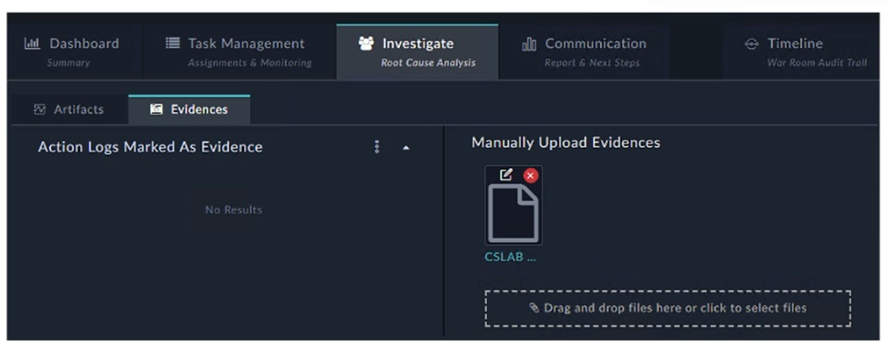
How do you add a piece of evidence to the Action Logs Marked As Evidence area? (Choose one answer)
Comprehensive and Detailed Explanation From FortiSOAR 7.6., FortiSIEM 7.3 Exact Extract study guide:
In FortiSOAR 7.6, the War Room is a collaborative space designed for high-priority incident investigation. The Evidences tab within the Investigate view (as shown in the exhibit) is specifically designed to highlight critical findings found during the investigation process.
Evidence Tagging: To populate the Action Logs Marked As Evidence section, an analyst must specifically tag a relevant log entry, a playbook output, or a comment within the collaboration workspace with the system-defined keyword 'Evidence'.
Automatic Categorization: Once the tag is applied, FortiSOAR automatically parses these entries and displays them in this centralized view. This allows team members and stakeholders to quickly view substantiated facts and proof gathered during the 'Root Cause Analysis' phase without sifting through all raw action logs.
Manual vs. Action Logs: The exhibit shows two distinct areas: 'Manually Upload Evidences' (where files like the CSLAB document shown can be dragged and dropped) and 'Action Logs Marked As Evidence.' The latter is reserved exclusively for system-generated logs or comments that have been promoted to evidence status via tagging.
Why other options are incorrect:
By linking an indicator to the war room (B): Linking indicators associates technical artifacts (like IPs or hashes) with the record, but it does not automatically classify them as evidence within the War Room action log view.
By creating an evidence collection task and attaching a file (C): While this is a valid step in an investigation, attaching a file to a task typically places it in the 'Attachments' or 'Manually Upload Evidences' area, rather than the 'Action Logs' section specifically.
By executing a playbook with the Save Execution Logs option enabled (D): Saving execution logs ensures a trail of what the playbook did, but it does not mark the output as 'Evidence' unless the specific logic or a manual analyst action applies the 'Evidence' tag to the resulting log entry.
You are designing a FortiSOAR hybrid multi-tenant deployment. The architecture must support remote tenant execution and automation inside segmented networks. Which three elements are true for this design? Choose three answers.
Exact Extract: ''Hybrid tenancy * Some tenants are distributed, but some are shared.'' The guide also states that shared tenancy uses ''one FortiSOAR instance'' for multiple tenants and that ''tenant data is isolated from other tenants through RBAC.''
Exact Extract: ''The master cluster is a hybrid multi-tenant deployment because shared tenants are hosted locally on the cluster, in addition to the remote tenants that communicate through an SME.'' It also states that the SME uses TCP 5671 and that ''each tenant node has a dedicated space with the SME.''
Exact Extract: ''For isolated and segmented networks, you can deploy a FortiSOAR agent to receive and execute connector actions... The agent requires outbound network connectivity only to the SME on TCP port 5671.''
The correct answers are B, C, and D. In a hybrid multi-tenant FortiSOAR design, the master cluster can host local shared tenants while also communicating with remote distributed tenant nodes through the secure message exchange. Shared tenants remain isolated through RBAC, so B is correct. The SME provides controlled message routing, and each tenant node has a dedicated space on the SME, so C is correct. Tenant nodes and agents use TCP 5671 to communicate with the SME, so D is correct. A is wrong because the guide says FortiSOAR can use either the embedded SME or a dedicated external SME; a dedicated SME is recommended for production scalability, but it is not mandatory. E is wrong because agents are deployed in isolated or segmented networks, not on the master cluster for HA performance.
Refer to the exhibit.
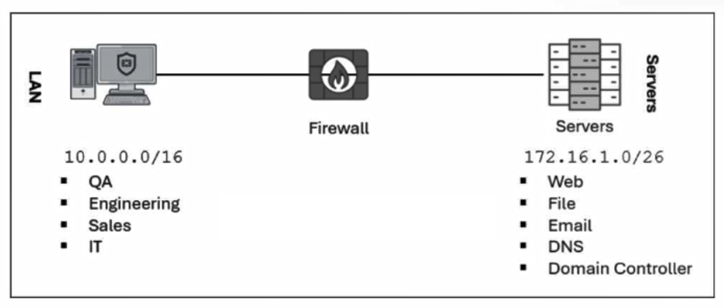
Which method most effectively reduces the attack surface of this organization? (Choose one answer)
Comprehensive and Detailed Explanation From FortiSOAR 7.6., FortiSIEM 7.3 Exact Extract study guide:
In the context of the Attack Surface Management modules within the FortiSIEM 7.3 and FortiSOAR 7.6 security frameworks, 'reducing the attack surface' refers to the process of minimizing the number of possible entry points (attack vectors) that an unauthorized user could exploit.
Definition of Attack Surface: The attack surface consists of all the different points where an attacker could try to enter data to or extract data from an environment. This includes hardware, software, SaaS components, and network interfaces.
Effectiveness of Asset Removal: Removing unused devices, services, or software is the most fundamental and effective way to reduce the attack surface. By decommissioning an unused server or workstation (as shown in the LAN/Server diagram), you completely eliminate all potential vulnerabilities associated with that asset, its operating system, and its active services.
Contrast with other methods:
Forwarding logs (A) and Deep Inspection (B) are detective and preventive controls, respectively. They help manage the risk within the existing attack surface but do not actually shrink the size of the surface itself.
Macrosegmentation (C) limits the 'blast radius' or lateral movement after a compromise has occurred. While it secures the interior, it does not remove the initial entry points that define the external attack surface.
Why other options are incorrect:
Forwarding logs (A): This increases visibility but does not remove potential vulnerabilities.
Deep Inspection (B): This is a security measure to detect threats within existing traffic but does not eliminate the target (the device) itself.
Implement macrosegmentation (C): While highly recommended for security, it is a network architecture strategy to contain threats, whereas the prompt asks for the most effective method to reduce the surface. Removing the asset entirely (D) is the most absolute reduction possible.
Refer to the exhibit.
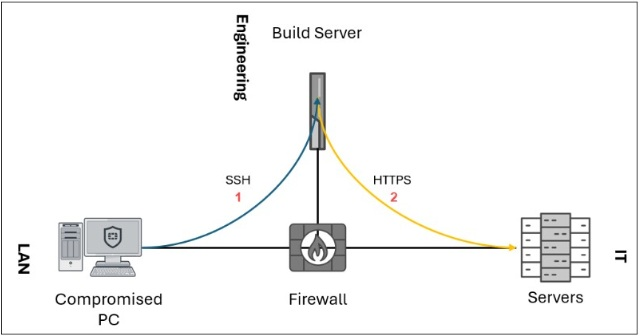
A compromised PC establishes an SSH connection to an engineering build server, which then relays HTTPS traffic to reach servers that would otherwise have blocked access from the LAN. Which technique is used for this attack?
Exact Extract: ''Next, they will use SSH tunneling to bypass firewall rules that prevent LAN devices from accessing some devices in the SOC network. They will be able to gain access to crucial network infrastructure.''
The correct answer is D. Protocol tunneling. The exhibit shows the compromised PC using SSH to connect to a permitted intermediary system---the engineering build server---and then using that path to relay HTTPS traffic toward internal servers that the LAN host could not normally access directly. That is tunneling: one protocol or traffic flow is encapsulated or relayed through another allowed channel to bypass segmentation or firewall policy.
A is wrong because port knocking is a stealth access-control mechanism where a sequence of connection attempts opens a port. B is wrong because the exhibit is about reaching internal servers, not stealing data through an established C2 channel. C is wrong because there is no interception or manipulation of traffic between two victims; the build server is being used as a pivot/tunnel.
Technical Deep Dive: In MITRE terms, this behavior aligns with tunneling/proxy-style defense evasion and lateral movement support. In real operations, an attacker may use SSH local forwarding, remote forwarding, or dynamic SOCKS proxying, for example ssh -L 8443:internal-server:443 user@build-server or ssh -D 1080 user@build-server. From a Fortinet SOC perspective, FortiSIEM should flag unusual SSH sessions from workstations to build servers, followed by unexpected HTTPS connections from the build server to protected server zones. FortiGate NP/CP offload may accelerate allowed sessions, but the detection value comes from log correlation and segmentation policy violations, not ASIC behavior.
Which FortiAnalyzer feature uses the SIEM database for advance log analytics and monitoring?
Understanding FortiAnalyzer Features:
FortiAnalyzer includes several features for log analytics, monitoring, and incident response.
The SIEM (Security Information and Event Management) database is used to store and analyze log data, providing advanced analytics and insights.
Evaluating the Options:
Option A: Threat hunting
Threat hunting involves proactively searching through log data to detect and isolate threats that may not be captured by automated tools.
This feature leverages the SIEM database to perform advanced log analytics, correlate events, and identify potential security incidents.
Option B: Asset Identity Center
This feature focuses on asset and identity management rather than advanced log analytics.
Option C: Event monitor
While the event monitor provides real-time monitoring and alerting based on logs, it does not specifically utilize advanced log analytics in the way the SIEM database does for threat hunting.
Option D: Outbreak alerts
Outbreak alerts provide notifications about widespread security incidents but are not directly related to advanced log analytics using the SIEM database.
Conclusion:
The feature that uses the SIEM database for advanced log analytics and monitoring in FortiAnalyzer is Threat hunting.
Fortinet Documentation on FortiAnalyzer Features and SIEM Capabilities.
Security Best Practices and Use Cases for Threat Hunting.
Get access to all 96 verified questions with detailed answers.
Unlock All NSE7_SOC_AR-7.6 Questions