NSE7_SSE_AR-26 Exam Questions & Answers
Fortinet NSE 7 - SASE 26 Architect • Fortinet
100% money-back guarantee
Sample NSE7_SSE_AR-26 Questions
Practice with real exam-style questions, each with the verified correct answer and explanation.
Refer to the exhibit.
Two hub-and-spoke groups are connected through redundant site-to-site IPsec VPNs between Hub 1 and Hub 2.
Which two configuration settings are required for spoke A1 to establish an auto-discovery VPN (ADVPN) shortcut with spoke B2? (Choose two.)
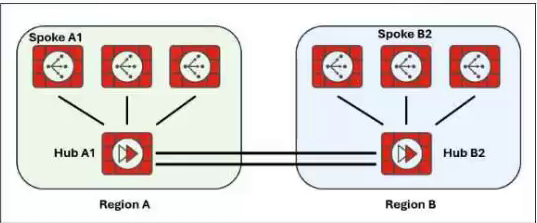
Exhibit --- Hub-and-spoke ADVPN topology
ADVPN enables dynamic spoke-to-spoke IPsec shortcuts that eliminate unnecessary transit through hub devices after the initial discovery and negotiation process. In this scenario, spokes A1 and B2 belong to separate hub-and-spoke groups, interconnected through redundant IPsec tunnels.
Option A is correct because spoke devices use auto-discovery-receiver on their hub-facing IPsec Phase 1 interfaces. This enables the spokes to receive ADVPN shortcut discovery information needed to establish a direct tunnel to another spoke. Fortinet's ADVPN configuration examples explicitly demonstrate this receiver role.
Option D is correct because the interconnected hubs must forward the relevant ADVPN discovery messages across their inter-hub IPsec tunnels. Enabling auto-discovery-forwarder allows discovery signaling to traverse the hub-to-hub connections so that spokes belonging to different regions can discover one another.
Option B reverses the standard spoke and hub discovery roles. The hub normally performs the sender role on its spoke-facing tunnels, whereas the spoke uses the receiver role.
Option C similarly assigns the receiver role to the wrong side of the hub-to-spoke relationship.
The essential distinction is between receiving shortcut discovery at the spokes and forwarding discovery information between the hubs.
Which component, typically categorized under network edge connectivity rather than cloud-delivered security controls, is incorporated as a foundational element within a secure access service edge (SASE) architecture but is not considered part of a security service edge (SSE) framework?
Secure Access Service Edge combines enterprise network connectivity with cloud-delivered security services to provide consistent protection and optimized application access across distributed environments.
Option B is correct because Software-Defined WAN represents the networking component of SASE. It provides intelligent WAN connectivity, application-aware path selection, transport abstraction, and centralized traffic steering.
Security Service Edge, by contrast, focuses specifically on delivering security services from distributed cloud enforcement points. It does not inherently include the SD-WAN networking functions that form part of the broader SASE architecture.
Option A is incorrect because SWG is a core SSE capability that protects users against malicious websites, unwanted content, and web-based attacks.
Option C is incorrect because ZTNA is another fundamental SSE component. It implements explicit, identity-based access to authorized applications rather than granting unrestricted network connectivity.
Option D is incorrect because CASB provides visibility, governance, and security controls for cloud applications, making it part of SSE.
Fortinet implements the networking portion of unified SASE through FortiGate Secure SD-WAN and delivers SSE capabilities through FortiSASE.
Together, they provide secure internet access, secure private access, and secure SaaS access while maintaining consistent enterprise security policies across users and branch locations.
Which two statements correctly describe what happens when traffic matches the implicit SD-WAN rule? (Choose two.)
The implicit SD-WAN rule serves as the final catch-all. In FortiOS operation: "Sessions matching the implicit SD-WAN rule do not have an SD-WAN service id, as they are not associated with any specific user-defined SD-WAN rule. Additionally, this occurs only when traffic fails to match any entry in the policy route table. This default handling guarantees connectivity while minimizing the risk of blackholed traffic."Administrators can observe this in diagnostic outputs for troubleshooting. An operational review should distinguish the rule that matches the traffic from the interface that is ultimately selected. Valid forwarding also depends on destination route eligibility, current member state and the applicable SLA or quality-selection algorithm. A diagnostic showing configured members alone is not conclusive evidence that all those members will carry a particular flow. When troubleshooting, correlate the configured SD-WAN service with diagnose sys sdwan service4, the live session entry and the routing table. An application signature, an IP route and a health-check result describe different decision stages; treating them as interchangeable can produce incorrect conclusions about the egress interface.
Refer to the exhibit. How does FortiGate handle the traffic with the source IP 10.0.1.130 and the destination IP 128.66.0 125?
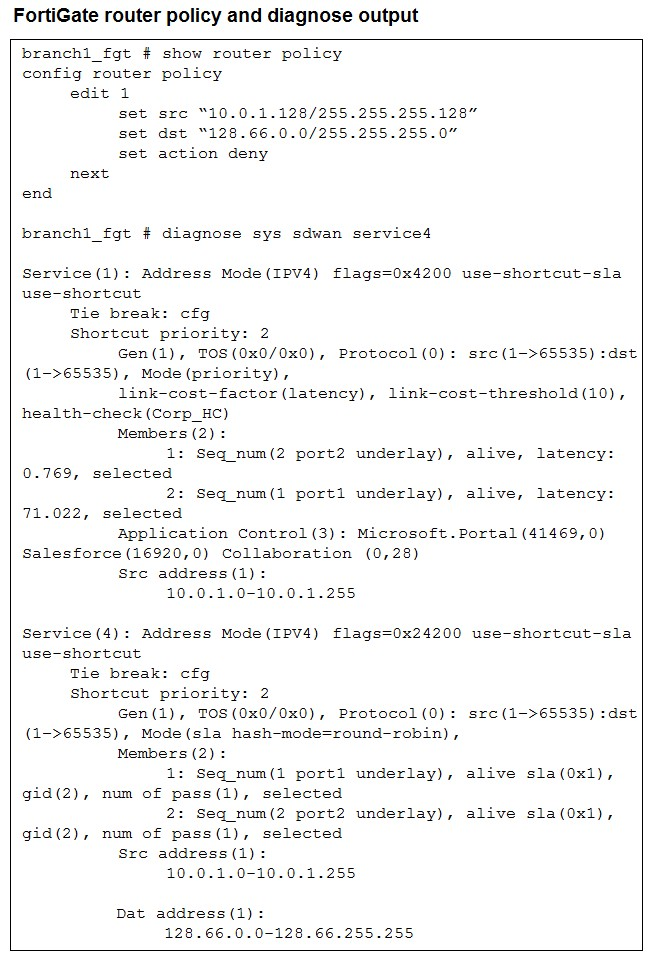
Exhibit 1
The matching router policy uses set action deny, which is not equivalent to a firewall security-policy deny. Within config router policy, the deny action stops policy-route processing and returns the packet to normal forwarding-information-base route evaluation. Both source 10.0.1.130 and destination 128.66.0.125 match the configured policy-route ranges. FortiGate therefore uses the FIB to select forwarding, subject to a valid route and an accepting firewall policy. The candidate answer key incorrectly claims SD-WAN load balancing, and its explanation incorrectly claims the traffic is dropped. Both contradict FortiOS policy-route semantics. Reference: FortiOS 7.6 CLI Reference --- config router policy, action deny; Fortinet Technical Tip --- Stop Policy Route. An operational review should distinguish the rule that matches the traffic from the interface that is ultimately selected. Valid forwarding also depends on destination route eligibility, current member state and the applicable SLA or quality-selection algorithm. A diagnostic showing configured members alone is not conclusive evidence that all those members will carry a particular flow.
An administrator is attempting to create two static routes: one for the SD-WAN zone wan-link and one pointing to a specific SD-WAN member interface that currently belongs to the wan-link zone.
Which configuration is required to make this scenario valid? (Choose one answer.)
According to the Fortinet SD-WAN 7.6 Core Administrator Study Guide, Routing and Sessions, page 193, FortiOS supports static routes referencing SD-WAN zones and individual member interfaces. However, duplicate destination routes cannot simultaneously reference a zone and one of its individual member interfaces.
Option A is correct: FortiOS requires the two static routes to have different destination prefixes. When a static route references an SD-WAN zone, FortiGate creates forwarding entries for the members belonging to that zone. Configuring an additional route with the identical destination prefix through an individual member creates a conflicting route definition.
Overlapping destination networks are permitted when their prefixes differ. For example, a zone-based route could reference 10.0.0.0/8, while a member-specific route references 10.2.0.0/16.
Option B is incorrect: Equal administrative distance does not resolve the duplicate-route restriction. ECMP is not a substitute for valid route configuration.
Option C is incorrect: FortiOS supports default static routes (0.0.0.0/0) referencing SD-WAN zones.
Option D is incorrect: SD-WAN members can include physical interfaces, VLAN interfaces, IPsec tunnels, and other supported interface types.
Therefore, the two static routes must have different destination prefixes, although overlapping networks are allowed.
Exact Source Reference:
Fortinet SD-WAN 7.6 Core Administrator Study Guide, pages 192--193 --- Routing and Sessions.
FortiOS 7.6 Administration Guide --- Adding a Static Route and SD-WAN Members and Zones.
Get access to all 110 verified questions with detailed answers.
Unlock All NSE7_SSE_AR-26 Questions